Tuesday, October 31, 2006


A loaded boo-fet.

A nightmare on Sesame Street

Boil, boil, toil and trouble

Itsy bitsy spider

Dylan and Jessica engage in battle

Rev. Nathan lands on his duff.

Jessica and Kenley enjoy the evening

Kelsey makes her way down the slide in grace

Dylan scales the wall.

Ross and Ashley in a dead heat

Kenley wasn't expecting the camera

Wesley serenaded by a communion usher

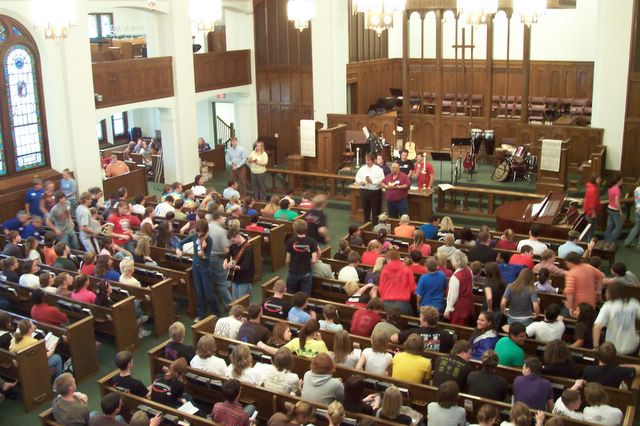
Youth from around the conference worship at Stillwater FUMC

Sunday, October 29, 2006

All Saints day sermon

Scriptures
Isaiah 25: 6-9
John 11: 32-44


Our scriptures today are wonderful and complex. In our Gospel lesson we heard of Jesus’ most significant miracle because he demonstrated his power over death itself. This miracle was the raising of Lazarus. When I think of this scripture, I have in my mind the images from a film that has nurtured my faith—so I’d like to share those images with you. They come from a film that stirred up a lot of controversy and in turn was overlooked by much of the Christian community: The Last Temptation of Christ.
………………….
There are several symbolic acts in this scene that I think are very powerful testimonies of Christ’s identity for us as the church. They are powerful because like the rest of the novel and the film adaptation, they speak powerfully to the humanness of our savior Jesus Christ. First, Jesus stands at the entrance to the tomb and thrusts his hands through the invisible barrier between the outside of the tomb, where living is done, and the inside of the tomb—the domain of death. It is a powerful visual symbol for us for the identity of Christ who defeats death. He has set the stage for what follows—a description of how death is defeated by Christ. After Jesus issues his command into the tomb, first a whisper, then appealing to the prophets and heroes of his faith, then finally with a command coming from his own heart, he kneels in prayer at the tomb for what seems to be a while.
He is startled when the rotting hand of Lazarus reaches up for him. Pensive as he contemplates the magnitude of his actions, Jesus then reaches his hand into the tomb. Death’s hand at first re-acquaints itself with the living, then with desperation grasps hold and pulls Jesus into the tomb with him. For me, these are powerful and imaginative additions to the story we have in our scriptures. They speak to Jesus’ identity because they describe for us how Jesus came to defeat death for all of us.
God, in Jesus Christ, defeated death by taking it on himself. By being pulled into the tomb to experience all that we experience….and then—embracing us even still. Did you notice that? Instead of turning away in fear and repulsion to the corpse that is pulling him in, Jesus embraces Lazarus in the tomb and pulls him back into the living! Jesus gives us new life because Jesus embraces us and pulls us out of our tombs and into life again. In life and in death and in life beyond death, we never leave the loving embrace of our savior.
Fortunately for us Methodists, most of the images of the life to come in the Scriptures are feasts. God knows we Methodists like to eat! Isaiah paints the picture of rich food, well aged wines—white and red! And rich food filled with marrow—YUM! As we all sit at the table with the rest of the human family, God provides the dinner entertainment—a great shroud or sheet symbolizes our death—it is as if the table is set on it as the tablecloth. Like a magician, God strips the tablecloth from under the feast without a glass of that well aged wine spilling on the table. Then, he takes the shroud and swallows it. We all applaud. He wipes away every tear and fills our hearts with gladness—he wipes disgrace from the ends of the earth.
This week we celebrate the continual life of those saints who have gone before us. It is All Saint’s Day this week. The first of November was in the old calendar the beginning of the year. The harvest came to completion and great feasts were held. During these feasts, those who had passed away in the previous year were uplifted, celebrated, and preserved in memory.
It is also in the tradition of this church a youth Sunday, when young people are lifted up, celebrated, and involved in the worship leadership of this congregation. It occurred to me that it would be greatly symbolic for our youth to lead the congregation in its remembrance of its departed. It is symbolic to me because God holds us as precious in our infancy, in the early stages of our walk of faith, all through our lives to our deaths and finally beyond our death. God’s power and presence is made most manifest when we worship as a family—old and young, vibrant and tired. We worship a God who sets a feast for all. And our worship is the participation in that feast of life.
During our great thanksgiving today, we will lift up the names of those who have gone on to the next life during this past year. After each name is read, the bell will toll. A bell makes sound because it is hollow in the middle. The hammer strikes the inside of the bell, and then the sound reverberates out of the hollow opening, emitting vibrations in the air that continue to issue forth even after the hammer has struck.
Our lives have the same effect on the world around us. If our whole lives are symbolized by that brief strike of the hammer against the bell, then the meaning and influence that our lives bear on those around us echoes on long after that original strike of the hammer. The Good News of our Scriptures is that in the ear of God, that ringing never stops. We are loved to the extent that we are resurrected into a new life in the presence of our Maker.
Imagine a Savior who loves us so much that he embraces us even if we are repulsive to the world around us. Imagine that he personally pulls every one of us out of our tombs of self-doubt and sin and death and into new life in the light. Imagine that God desires our fellowship like a great dinner host that gathers all at a common table. Can you see those pictures? You don’t have to imagine—because that is what God is—that is indeed what Christ has done for us, and that is the reality that we celebrate as we come to the table of communion.
Because the reverberations of life are still fresh in our ears, and we are shaped not only by those who are members of this congregation but also those whom we know in other walks of life, I would invite you to name aloud others who have passed away in the recent past after we name aloud those who have touched your lives as well.

Wednesday, October 25, 2006

Worldwide

With the recent "hit" our website got in Egypt, we have now been accessed on every continent in the world. Want to see for yourself? Scroll down to the counter at the very bottom of the page, click it, then look around at our "viewer stats" on the sitemeter. You can view our visitors by world map by clicking "world map" on the left sidebar, then clicking "last 100" in order to see where our last 100 viewers accessed the site from. You can also view "by location" to see a list of all the places our website has been accessed. Most exciting to me is not that we have been looked at worldwide, but the frequency of use in Oklahoma. I'm glad you're finding this site useful!

Monday, October 23, 2006

Forklifters for Jesus

In case you or someone you know is interested, a school for forklift certification at the Muskogee Indian Capital Vo-Tech will be running for 4 days. Enrollment is $32.50 and opens Oct 23rd. Classes are Monday Oct. 30th through Thursday, Nov. 2nd from 5:30 to 9:30. (During the Camp Gruber Hurricane Katrina period last fall, it is my understanding they had a hard time finding people certified to drive forklifts.)

(A message from your DS)

Scripture for this Sunday

This Sunday we will celebrate All Saints day a few days early. We will also celebrate communion on this day. Instead of the normal lectionary readings, we will be using the lectionary readings for All Saint's Day. You can find them by clicking the Bible Study Link at the left, then clicking on "All Saint's Day."

The Big Fun Thing--Youth Event in Stillwater

Hey Youth!
The event is from 2:30-7pm on Sunday. We can be fashionably late if we leave here at 1pm. That'll give you time to get a bite to eat before leaving. Bring 8 bucks for cover charge. It'll be great, so join us and bring a friend. If you haven't already let me know you're coming, attach a comment below.

Sunday, October 22, 2006

Job 38: 1-7, 34-41
Psalm 104

You might have picked up on this from some of my other sermons—my favorite sanctuary is the outdoors. I don’t think I am that uncommon when it comes to this. I have spoken to many people who have a keen sense of God’s presence and power when they are attentive to nature. St. Augustine, one of the most influential Christians on our religion in all of history, wrote, “Some people, in order to discover god, read books. But there is a great book: the very appearance of created things. Look above you! Look below you! Note it. Read it. God, whom you want to discover, never wrote that book with ink. Instead he set before your eyes the things that he had made. Can you ask for a louder voice than that?”
I have had many great encounters with God in nature. My experiences have led me to a great interest and activity in the bridge between theology and ecology. When I was in seminary, I received a grant that allowed me to study and experience faith communities around the country that were involved in some kind of ethic or worship practice that incorporated the natural world around them.
I used some of the grant to travel to central Wyoming for a two week workshop retreat in the Wind River Range of mountains along a glacial lake called “Ring Lake Ranch.” The two weeks were spent horseback riding at 7 and 8 thousand feet, hiking, exploring petraglyphs, and attending lessons by a man named Belden Lane who wrote a book called Landscapes of the Sacred and The Solace of Fierce Landscapes.
On one occasion, I remember sitting in a little cleft in the rock that I had found that overlooked the glacial lake. The glacial lake had been formed thousands of years ago as the glacier had cut through the valley and left deposits of water sitting along its path. All of the lakes were connected by little streams, and the locals called them “string of pearls” lakes because of their beauty. My vantage point overlooked the lake and up the valley to the remains of the glacier that still covered the tops of some 10,000 foot mountains a mile or two up the valley.
As I took in the scene, I started to notice that the water would ripple in front of me, and then I would feel the cool breeze of the wind coming down the valley. As I focused closer, I began to notice that the lodgepole pines on the sides of the mountains in front of me also whistled and sang as the wind passed through their needles, and then when I turned to look further down the valley I could see the wind passing further and further along the valley.
In the Scriptures, the Holy Spirit is called Ruach, and it means “breath,” or “wind.” In today’s Psalm, the songwriter says of God, “You ride on the wings of the wind, you make the winds your messengers.” On this day, that scripture was burning on my heart. I felt God’s presence and power. The message that God gave me was, “I created all of this—all of this worships in its own way. The trees, the water respond to my breath—Do you?”
How do we respond? As a youth minister in Bartlesville, I planned and led two “environmental mission trips,” and while I was in seminary I created a student group called “Community of Faith for Healing the Earth.” The Psalmist also observes the breath of God animating all of life on Earth. The psalmist writes, “when you send forth your breath, they are created…when you take away your breath, they die and return to their dust.” Our scriptures tell us that what gives us life is the spirit, the breath of God. When I hear this, it causes me to want to do so much more with my life. It makes me want to live my life as praise to God. As the Psalmist says, “I will sing to the Lord as long as I live; I will sing praise to my God while I have being.”
The authors of the Bible are certainly attuned to God’s presence in and through the world around us. The Psalmist this morning paints imagery of God entwined with creation. We are told that the wind is God’s wings, that the sunlight is God’s garment. The world around us is infused with God.
I imagine that many of you who hunt and enjoy recreation in the outdoors have witnessed moments of great peace and inspiration as the Psalmist records. Many of the hunters I know are interested in the process of being outdoors and observing the world around us as much or more so than the actual felling of an animal.
An appropriate response to God’s grandeur which is observable in the overwhelming expanse of the world and universe around us is humility. Haven’t you ever looked up at the stars with the understanding that the light you observe now was actually emitted thousands and even millions of years ago and simply been overwhelmed, humbled?
God responds to Job’s interrogation with a lesson in humility. Particularly offensive to God is no doubt Job’s curse of his own day of creation in the third chapter. Job is so carried away with his own misery that he curses the day of his own conception. He utters seven curses in a symbolic attempt to undo the creation of the whole universe which is also symbolized by the number seven.
God says to Job, “were you there when…?” God’s intention is to remind Job that there is a large, full world, and that God’s design and vision are utterly transcendent and mysterious. We may question God’s fairness when we suffer, but when we do we must also remember the vast size of God’s intentions. We typically behave and live in the world as if we are God’s only creation. Our depletion of natural resources and our short-sighted pursuit of material goods and gratification are indicative of our arrogance as members of Creation. If the scriptures proclaim that God can be perceived by us through the majesty of the world around us—what does it mean when we damage our environment for our own short-term gain?
While I was in Wyoming, I also took this picture…. In this picture, you may notice that the bare tree and the cloud in the sky give each other a sense of completion. When I saw this sight, it inspired in me the notion that God’s creation is interconnected in strange and mysterious ways. Ecosystems that have carefully entwined processes and delicate balance remind us of this truth.
While the vastness of God’s grandeur apparent in the night sky or Grand Canyon or the sheer power of the Pacific Ocean may easily inspire us to feel small and humble, God asks us to also be humbled by the intricacy of life. In God’s response to Job, not only does he mention the sky and mountains and leviathan, God also draws Job’s attention to the composition of mud, to the appetite of the lion cub, and his own provision for the common raven. God intends for us to respect the balance of Creation and to live as a harmonious member of creation.
Because we do worship a God who is attentive to all of His creation, and we do worship a God who charges us with the responsibility to be stewards of the Earth—I would ask us a faith community to come up with some creative ways that we can celebrate this covenant in our own community.
I have noticed that we do not have a recycling facility either in this town or in Okmulgee. Why not? Is that a need that can be addressed by the faith community, or a partnership between communities? We might also ask ourselves if the ease of use of Styrofoam is really worth the impact that these materials have on our environment. Our town is next to the Okmulgee landfill. Do we want the longest remaining evidence of our community here to be our coffee cups and plates? Our trash? In my own private estimation of easily addressable steps we could take to be better stewards of the earth—this is one that I see.
We live in a community that is easily traversed by bike or by foot. I would encourage everyone who is able to walk or bike when weather permits to church or on your daily errands or to work. I have found that you see a lot more of your community when we view it from this vantage point.
We worship God through our attention to our personal lives, our morality, our love for neighbor and those in need. We worship God through our celebration of Jesus Christ. We also worship our Creator by living as faithful stewards of the Creation. God has blessed us with unique power—the faculties of reason and skill. With these faculties and without the inspiration of God we have developed a way of life that is not sustainable because it is destructive to the world around us—destructive to our human and non-human neighbors. God gives us gifts of reason and skill, God creates us in his image with these tools—but we must be attentive to God’s word as we use these gifts. We are asked to be caretakers of the earth—our lives and the delicate balance of God’s creation depends on it! In Costa Rica, wildlife preserves contain human communities as well as wildlife because the government realizes that humans are part of the ecosystem and can be a benefit to it if they live within their niche.
How can you live as a steward of creation? How does God communicate with you through the world around you? How do we, as children of God, share our faith in God by our engagement with the ecosystem in which we live? Throughout the scriptures, we are reminded of God’s power and majesty in the beauty and intricacy of Creation. Furthermore, We are blessed with the ability to share in God’s act of creation. Let us use this ability with humility and with celebration of God’s presence in our lives. Amen!

Tuesday, October 17, 2006

Give input on new UMC website. Clink link to the side, or the stained glass pic of Jesus

UMC.org Offers Preview of New Web Site
Online Survey Solicits Consumer Feedback
NASHVILLE (October 17, 2006) United Methodist Communications is asking visitors to UMC.org, the official online ministry of The United Methodist Church, for feedback on a cutting-edge redesign of the Web site.
The home page of www.umc.org offers a sneak peek at a few of the innovative features that will be offered on the new Web site, scheduled for a full launch in early 2007. Six online surveys provide opportunities for users to offer comments and opinions for consideration before the site is finalized.
“Our goal is to make it easier for people to connect to the church and to each other through technology--to provide a digital front door to the church. Throughout the development process, we have sought to listen to what it is that users want in a website and to provide the tools, resources, and content to meet those needs,” said the Rev. Larry Hollon, chief executive of United Methodist Communications. “We want to know if we’re meeting their expectations.”
The sneak peek showcases:
Our People: Meet some of the people of The United Methodist Church and read their stories of faith
Find a Church: Reach out to seekers in your community by showcasing your primary ministries
Living Prayer Center: Send prayer requests to covenant prayer groups around the world
Spiritual Gifts: Discover your spiritual gifts using an online assessment tool
Ask InfoServ : Get your questions answered through the denomination’s official information service
Search: Quickly find the information you are looking for using the Google search device
The sneak peek offers just a sample of what’s to come over the next few months. Users can sign up for e-mail updates letting them know when new features are added.
In addition to providing feedback, local churches are asked to update and personalize individual church listings available at Find-a-Church. Users can search the database of churches by geographic location, congregation size, language and ethnicity. Local congregations can use this feature as an evangelism tool by adding details about their worship schedule and activities, words of welcome, photos of the church and pastor, membership statistics, an interactive map and driving directions, and more.