Sunday, May 24, 2009

Sunday, May 17, 2009
Celebration of Graduates Sermon
Sermon Texts:
John 15: 9-17
1 John 5: 1-6
Conquering the World
Five seniors, big plans. As you look at the prospect of going out and living on your own, you no doubt feel like you can do anything! You can “conquer the world,” as the saying goes, right?
I remember my plans upon graduating high school: they weren’t all that grandiose. I just wanted to be Indiana Jones. No, this wasn’t my childhood vision of what I wanted to be when I grew up, this is what I told the announcer to say when he introduced me and some other attendees of governor’s school at a football game.
I had a hat, a whip. I was ready to rock. I got to college and loaded up on history courses. I signed up for a 2 term, 200 level “History of China” because that’s where I was interested in beginning my career as a next generation adventuring archaeologist.
I took a music appreciation class because I figured it would be easy and I’d have more time to focus on my budding plans for world travel and intrigue. After the first term, the music appreciation class ate my lunch, (the prof. had grown accustomed to people thinking his class was a “gimme” and had developed a series of tests and papers that would give people their just desserts for making such a presupposition.)
So, things changed, as they usually do. Our plans take some detours that we don’t anticipate. Things crop up that we were unaware of.
You can have everything laid out in one grand scheme and then one unforeseen event, one minute of life, can change your whole direction. When I worked in college ministry, I began to realize that I could almost predict with certainty which students would be having a crisis of the soul by their second year by how fixed and certain their plans for their life were in their first month of their first term on campus. What can we do in such an uncertain world?
John has a strategy for conquering the world that actually works: Faith.
He says, For the love of God is this, that we obey his commandments. And his commandments are not burdensome, 4for whatever is born of God conquers the world. And this is the victory that conquers the world, our faith. 5Who is it that conquers the world but the one who believes that Jesus is the Son of God?
Now, I hope you didn’t just hear the last thing I said. If you just heard the last thing I said, then you may think that conquering the world is a matter of belief, like there’s a secret way to “believe” something into existence, and if you just hold on to that belief, if your head just cognates the right kind of ideas, you will overcome anything.
Belief is a powerful thing, and I know of some people who have gotten through some difficult times just by “getting their head right.” But for most of us, I think, we might have a little less confidence in the power of “mind over matter.” Our minds can play tricks on us, after all. We might imagine all sorts of things.
Fortunately God makes it easier on us. To pull one verse from 1 John that seems to say that the world conquering faith is a matter of belief doesn’t jibe with the rest of 1 John’s message. If we know anything from John, it is that faith is more than belief. Look at the beginning of the passage: “For the love of God is this, that we obey his commandments. And his commandments are not burdensome, for whatever is born of God conquers the world.”
What is the chief commandment? “Love one another as I have loved you.” Believing in this principle means enacting it. This is how we conquer the world instead of letting the world conquer us.
Be assured of that. The world, and the imposter who make believes that he is the owner of the world, is actively seeking ways to conquer us. The Tempter who offers Jesus the world and all that is in it because it belongs to him wants to fool us. The force of evil has its own tactics of conquering the children of God by fooling them out of their inheritance as children of God.
Sometimes it’s the bait and switch, such as when Satan takes something good and life giving, such as sex and intimacy, and we become twisted into believing that the purpose of such things are meant for nothing more than the satisfaction of an urge.
It becomes corrupted into something we can “get” instead of something that we share. “I want to ‘get some.’” Such an outlook on sex and intimacy has the effect of bending the whole arc of our lives toward chasing the next fleeting gratification. Perhaps this is why Dante portrayed the souls in Hell that had given in to lustfulness as literally being blown around by the wind: Unsubstantial and wispy in their eternal state of being.
Or, take wine and drink and merriment, which the Scriptures praise in verses like Psalm 104:15. “God makes wine for the gladdening of the heart.” The world ensnares us with something good and life-giving, and twists our mind to believe that drunkenness is gladness. Or we are deceived into believing that our reputation and stature are enhanced and built up in the minds of others by how drunk we might get in front of them.
May those deceptive lies of Satan be purged from your souls like the vomit that spews from your mouth when you overindulge in something God meant for something life-giving. Those lies can kill you. And if they don’t kill you, they have the power to conquer you: your mind and body and soul, which Jesus commands us to offer to God, will become the slave of a substance.
If you find yourself in the midst of such lies, put your faith into practice. Treat others with the love and respect that you want to be treated with yourself. Serve God through acts of service and charity toward the marginalized and oppressed, the poor and the sick. This is what a belief in Jesus Christ entails. This is the commandment that is no burden. This is how we will conquer the world. Let Love Rule
Loveis gentle as a rose
And love can conquer any war
Its time to take a stand
Brothers and sistersjoin hands
We got to let love rule
Let love rule
We got to let love rule
Let love rule
Love transcendsall space and time
And love can make a little child smile
Oh cant you see
This wont go wrong
But we got to be strong
We cant do it alone
We got to let love rule
Let love rule
We got to let love rule
Let love rule
Monday, May 11, 2009
Mother's Day Sermon
Texts: John and 1 John
My mother, like many of our mothers, spent the years that my sister and I were in the home being a home-maker. That was her profession, and she did it well. It wasn’t just about housework or making breakfast, lunch, and dinner. It wasn’t just about hauling my sister and me in the car to gymnastics meets, tennis practice, boy scout meetings, or youth group. I sense, now that I have had the chance to make a home for my own children along with my own wife, that home-making was and is about creating a haven: a place where my family could rest assured, where we could “be ourselves,” a place where we could be loved.
Wesley’s notes
8. God is love - This little sentence brought St. John more sweetness, even in the time he was writing it, than the whole world can bring. God is often styled holy, righteous, wise; but not holiness, righteousness, or wisdom in the abstract, as he is said to be love; intimating that this is his darling, his reigning attribute, the attribute that sheds an amiable glory on all his other perfections.
No, it is not just the mother’s responsibility to create a home where the Divine attribute of love can be nurtured and strengthened in us. Especially in this day and age when we find most couples sharing the responsibility of “bringing home the bacon.” It is indeed the responsibility and the joy for both partners in a marriage to have this task of “home-making” before us.
But today we lift up the feminine element of that task and we celebrate the mothers in our midst who have contributed so much to this element of our lives. Making a home for us.
I’m speaking so much about home-making, because it is the focus of our scriptures today. Today we lift up God’s activity of home-making. We hear from the letter of John that “if we love one another, God lives in us, and his love is perfected in us.” The Gospel of John shows Jesus comparing himself to a vine and his disciples to branches. “Abide in me and I will abide in you, and you will bear much fruit. Because apart from me you can do nothing.” Abiding—Peterson translates this word in the message as “Make your home in me as I do in you.”
Mothers show us quite literally what it means to make a home for another living being in them when they carry children in their wombs for 9 months, waiting to bring forth life. I think this “maternal instinct” that Rob Bell speaks about in the video is created during this time. Because once a woman brings forth a child, she “lives in them” in a very real way.
It is this same kind of nurturing relationship that Isaiah ascribes to God. God has a fierce maternal instinct about us as well.
21. And this commandment have we from him - Both God and Christ. That he who loveth God love his brother - Every one, whatever his opinions or mode of worship be, purely because he is the child, and bears the image, of God. Bigotry is properly the want of this pure and universal love. A bigot only loves those who embrace his opinions, and receive his way of worship; and he loves them for that, and not for Christ's sake.
This is how we make a home for our God. We make things familiar to God by reflecting God’s nature in our lives. We love others without hesitance because God is Love. This is how we bear fruit in the world. It only takes Love. All you need is Love.
Thursday, May 07, 2009
May 3rd Sermon, Love is Real
Don’t you think the word “love” has lost some of its potency? We use it in this day and age to mean so many things. “I love a good steak.”
This is why John’s advice is especially crucial for us today. He cuts through the hollowness of language. He says, like John Lennon later wrote in a song:
Love is Real. It is real when we put it into action.
Actions Speak Louder than Words:
Favorite saying of my mother.
This is crucial for us to understand, because it is the way of Jesus.
Book by Eugene Peterson.
This is the way of Christ—it is acting out of love for our brothers and sisters. Just in case we think “laying down our life for our brother or sister” is too demanding, John de-literalizes it for us. If we have the means to help someone in need, and yet we do not—it is obvious to the world and to God that we have no interest in this person called Jesus Christ. If we profess Jesus as the truth, and yet make no attempt to follow Jesus as the way, we dishonor God\
Friday, May 01, 2009
April 19 Sermon: The Benefit of the Doubt
Thomas used as a polemic against his community.
Importance of Xity seems to be belief/doubt. What about action/apathy.
1 John says it is not about what you profess, God’s focus is on whether you live in the light or in the darkness.
What do you think it means to “walk in the light.”
Do you live in an up front and honest way with people?
Do you lie or gossip?
To me, the witness of Thomas is that a skeptical nature doesn’t keep a person from experiencing God’s grace and forgiveness.
Why do we sometimes behave as though the point of all this, all this religion, is to pass along a set of beliefs, and the most heretical thing you can do is doubt the story. If we take a fuller look at the witness of scripture, we can see that the life lived is what counts. After all, as John says, you can say you are in fellowship with Jesus, but if your life is lived in the darkness—how can you be in the light?
Probably one of the reasons the 12 step program is so powerful and effective is because it asks its participants to come out in the open with the fact that they have a problem, and then bring to light those instances in the past that give you shame—go to the people whom you’ve wronged and own up to it. It is bringing a life lived in darkness into the light.
Thomas carried the gospel the furthest and over the largest area. Much of the world considers him the greatest apostle. Carried gospel through Syria, Persia, Afghanistan, India. His first converts carried the faith into China and even Japan by 70ad. That is the same year the Temple was razed by the Romans, and before the Gospels were all composed.
Thomas had a career many times more far-reaching than Paul.
He is the first to address Jesus as “God.”
Benefit of the doubt is that it engages us in theological thinking. It deepens and enriches our faith to question.it. IF it is an off limits place, it can get murky and stagnant. Faith needs to be stirred up, it needs to be flowing and active.
It needs something to prod it along. The benefit of the doubt is that doubt and questioning makes a faith vibrant and living. If you put faith and belief behind a locked door, you may forget to feed it and it will die of starvation and neglect.
The experience of doubt has for me been the experience of honesty. It is when I am most honest with myself and others that I feel as though I’m “living in the light.” And it is when we live in the light that we find ourselves in the presence of Christ—the Light of Lights!
I usually think of our lives lived as stained glass windows. We all have our own colors, and God’s light, which is Pure Light, is made up of all our colors. When we live in the light, we reveal an aspect of God to the world. I think a reason our tradition and expression of Christianity involves stained glass windows is because of this truth.
When we let the light shine through us, God reveals Himself to the world through us. A window displays the light, and when we participate in the community of faith through an active belief, we form a wonderful picture of God.
Imagine a person coming in to a church with beautiful stained glass windows only because it is the place where the feel the warmth and beauty and security of the love of God.
St. Jerome, another Church Father, tells us that John constantly repeated one refrain in his old age: "Little children, love one another."
So may we “live in the light,” which includes being open about our doubts and misgivings. May our doubt activate attention to our faith life. When we profess our faith, may it seem redundant, due to our lived life, to the world around us. As my mom always told me, “Actions Speak Louder than Words.”
Tuesday, April 14, 2009
Easter Sermon: The Rest of the Story
Sermon Notes
Today’s Gospel reading reminds me of a Paul Harvey radio spot. I’m sure everyone remembers Paul Harvey, the master storyteller who died this past Feb. who had been on the radio in Chicago for 50 years.
He’d start a story, say about a 13 year old boy who received a cash prize from Franklin Roosevelt, and then after a commercial break we’d find out that “the rest of the story” was that the 13 year old boy was one Fidel Castro. Little chance encounters and surprise endings were to be expected on Paul Harvey’s show.
So today’s scripture reading sounds like the first half of a Paul Harvey radio spot. It lacks that satisfying conclusion. In fact, the original Greek is even more incomplete and dissatisfying, ending in the conjunction gar, which means “for.”
A literal translation would be “So they went out and fled from the tomb, for terror and amazement had seized them…they were afraid for…” Tom Long says “It is almost as if the author of Mark had suddenly been dragged from his writing desk in midsentence.”
So, no doubt some of the fourth and fifth generation of Christians saw the ending unfit for a Gospel of Jesus Christ—especially in comparison to some of the other Gospels available—with their inspiring stories of the appearances of Jesus. Who wants to receive a Gospel which ends with the disciples of Jesus being afraid?
So they tagged a few of them on there to the end of Mark. But, we know how Mark’s gospel truly ends because we have the written testimony of some of our most trusted Church Fathers who speak about Mark’s ending without referring to these other endings.
Story about actor who memorized Mark, went with original ending….uncomfortable silence at end. “AMEN!” Decided that his conclusion had betrayed the original intention of the author.
Second night, walked briskly off stage after saying “and they said nothing to anyone, for they were afraid.”and the audience was stunned. He said the electric buzz was palpable among the people as they left that night as the audience talked with each other about the non ending.
This electric charge is what some Biblical Scholars believe was the intended result of ending the story in this way. It is compelling. It grips us and makes us want to enter the story and grab the women by the shoulders and shake them.
Mark’s Gospel is known for something called the “Messianic Secret” At every turn, when Jesus performs some miracle or healing, he orders the recipients or the witnesses to remain silent about the implications of such things. It is as if Jesus is afraid of the consequences of the cat getting out of the bag. It’s at the end of the first chapter, when he heals a leper and then “sternly” tells him not to mention it to anyone. Mark 8: 27-30
And in every case, Jesus’ own instructions to keep silent are disobeyed. The word gets out, and the movement grows. Some say the reason Jesus wanted to keep his identity a secret was because he wanted to re-define the meaning of a Messiah. The Hebrew people had certain expectations about what the Messiah would accomplish.
Scriptures told them the Messiah would rise up and dispel the conquering forces. He would free Israel and sit on the throne in glory and splendor. He would be the return of King David, who many Jews spoke of with the same sense of romanticism that our own culture remembers the mythical King Arthur.
So, the secret in this instance is reversed—the women are charged to Go and tell, and instead they run and hide. They are finally given the go ahead to spread the message far and wide, because now no-one will co-opt the movement of this Messiah and try to turn it into something it is not. Now Jesus is not able to be grasped and manipulated. He tells Mary in the Garden in John’s resurrection account, “Don’t grasp onto me.”
“But go,” the young man said, “tell his disciples (and be sure and tell Peter too) that he is going on ahead of you to Galilee.” (Galilee? Plain old ordinary Galilee where it all began?) That was the women’s “home turf,” Lamar Williamson said. The sort of place where the “same old same old” (routine) happens.[i]
“Yes! The messenger said—that’s exactly where you’ll see him just as he told you” (Did he tell us that?)
So, the Messiah returns to his disciples in exactly those kinds of moments. He joins them in a locked room as they are hiding out in fear of the authorities. He joins some as they are back to the old routine of fishing, and he cooks fish and bread with them on the lakeshore. He joins two on a walk from one town to another, never revealing himself until right before he leaves.
Instead of the Messiah coming in glory and transforming the world in some strong armed display of God’s strength, this Messiah who was put to death on a criminal’s cross makes resurrection appearances in the midst of the mundane and transforms our lives so that we might transform the world into the one God envisions empowered by the Spirit of God.
Did you notice the young man’s instruction included some specific instructions to be sure to include Peter too? Why single him out? Because Peter is the one who on this day is probably still bogged down and sulking in his guilt for denying his Master three times. The resurrection includes this major revelation that can transform even the most shamed disreputable lives and actions: You are forgiven.
This is the rest of the Story—as Paul writes to his friends in Corinth—Jesus invades the mundane and shameful lives we lead, and can transform them with forgiveness and grace. This forgiveness and grace inspires confession. Then, Christ can use that transformed life to accomplish amazing things.
It is the kind of transformation that inspires, even compels us to spread the message. We are loved and cherished by God! Paul was able to spread the message of Jesus far and wide, and his letters are the first written records that we have of the movement to which we belong.
The meaning of the resurrection is that Christ enters our lives in the here and now—in the mundane or unexpected—in the Galilees of our own lives. In the midst of our relationships with spouses, family, work-friends, and neighbors: Christ is Risen! In the midst of daily tasks and chores, and work and play: Christ is Risen!
The story is unfinished because it includes you and me and future generations. It acknowledges the reality that our first instinct is to shrink from the truth that will change our lives and run the other way instead. But the “rest of the story” is that our weakness, our fear and our frailty doesn’t impede the advance of Christ, who comes into this day and all days with a resurrected truth that we are forgiven!
This is the day the Lord has made and it’s going to be a ………..
Good Day!
[i] Interpretation, A Bible Commentary for Teaching and Preaching—Mark,
Thursday, April 09, 2009
Palm Sunday Sermon
Mark 11: 1-11
Notes:
Always loved Palm Sunday—parade! Here’s a celebration that we remember by getting actual palm branches and waving around—it really puts us in the story. We’ve started the Easter Celebrations!
However, I’ve also come to see this day as a precursor to the less glamorous occasions and stories we’ll hear about later in the week.
We’ll hear about Jesus gathering his friends together in the upper room and giving them bread and wine and telling them it is his body and blood. We’ll hear him give his final mandate that his disciples should “love each other as I have loved you.” He’ll say this after having gotten on his knees and washed their feet—a task that was usually reserved for slaves.
We’ll hear about his journey to the cross, and his ultimate crucifixion with 2 criminals. We’ll hear him cry out to God with his last breath a passage from Psalm 22, “My God, My God, Why have thou forsaken me?”
We prefer the solace and peacefulness, the sureness of Psalm 23 to the anguished cry of Psalm 22, and so many of us just stay home and skip the holy memorializing of these events during the week. We skip right on over from the promise of Palm Sunday to the Joy and exultation of Easter without registering what comes in between.
This is why it is important for us to acknowledge today—these Hosannas are hollow. This glory is fleeting. The crowd disperses before the processional even reaches very far inside the walls of Jerusalem. Mark tells us that at the climax of this parade, when Jesus is proclaimed and celebrated, he arrives in Jerusalem—then he comes home to the Temple! We are on the edge of our seats!
Can you imagine the elation of the disciples? We’re in this processional of people who have finally opened their eyes to the reality of the Messiah in their midst—when he gets to the temple, what will he do—tear it down and then miraculously build it back up as he promised to do a few days before? Will he gather his followers into a great mob and drive out the Romans who’ve filled the temple with their idols? Will he stride into the Holy of holies and tear down the curtain so that all may be in direct communication with their living God?
Mark grips us, and then snuffs out the narrative tension:
……he “looks around at everything and as it was getting late returns to Bethany with the 12.”
He “looks around at everything??????” What? Matthew and Luke both tell us that after the entrance on a colt (or 2 colts, oddly) Jesus storms into the temple and overturns the tables! Now that’s the kind of radical action we’d expect!
Yes, Mark’s narrative is a perfect preface for the tumbling disappointment that will be felt by all the characters in the upcoming days. It is no wonder we use these palms every year to begin Lent, when we burn them and place them on our heads as a sign of our “fair weather fandom” Too often we’re there proclaiming Jesus when the time seems right—when we get caught up by the crowd, but when we are faced with the one-on-one opportunity to make our witness with Christ, we fall short. We fall away. We deny our allegiance to Jesus.
These Palms make good ashes.
Maybe that’s why Mark focuses so much on the instructions Jesus gives his disciples rather than the parade.
Significance of riding a donkey: Zech 9:9
Rejoice greatly, O Daughter of Zion!
Shout, Daughter of Jerusalem!
See, your king [a] comes to you,
righteous and having salvation,
gentle and riding on a donkey,
on a colt, the foal of a donkey.
This text imagines a king who serves his people—who will work for them. Not Lord his kingship over them. King is humble.
The way Jesus arrives in Jerusalem is how he expects us to conduct ourselves.
Friday, April 03, 2009
Don Woods, Rest in Peace
Donald Dee Woods 73, died on Thursday, April 02, 2009. Don was born on September 24, 1935 in Okmulgee,Oklahoma to the late Henry and Donnie Woods. He was also preceded in death by a daughter DeeAnna McAlister and a son Mike Ray.
He is survived by his wife Topsy of the home, daughter Kathy Weimer of Henryetta, daughter Janet Wilkinson of Eufaula, daughter Susan Myers and husband David of Morris, son Randy Ray and wife Sharon of Okmulgee, son Stacy Hay of Mannford, daughter-in-law Sherry Ray of Okemah, special friend Matt Maxwell of Okmulgee, brother George Woods and wife Donna of Morris, sister Mary Grice and husband Ed of Morris, sister Linda Chasteen and Rick Sturman of Henryetta, 17 grandchildren, 6 great grandchildren, and a host of nieces and nephews.
Don was an avid fisherman, loved bowling, Nascar, his family, and Trixie. A memorial service honoring his life will be held on Saturday, April 4, 2009 at 2 pm at the McClendon-Winters Funeral Home Chapel in Okmulgee. Condolences may be made at mcclendon-winters.com.
Monday, March 23, 2009
Lent 4 Sermon Notes: March 23: Light and Dark
Why do farmers burn their fields.
Lent is the season that we “live the questions” instead of the answers. So today’s scripture is especially hard to wrestle with because it is a scripture many of us have a deep emotional connection with.
It offers a powerful and unmitigated answer. It envisions a stark contrast between light and dark.
John 3:16 is a scripture that many of us have committed to memory. It warms us with the feeling of being loved and prized by God.
Then, John goes on to speak about those children of light and darkness.
That kind of polarization can be dangerous. I prefer the parts of the bible that live into the ambiguity. Stories like ………..
John here and elsewhere gives us dichotomies. We are either in the light or the dark. I think I bristle at this outlook on the world because my experience of life is a walk in the sunshine and in the shadows, and often it is overcast. Not too dark, not too bright.
Looking over my journaling and sermon preparation with this text shows me that my struggle with this topic isn’t new. My previous sermon on this passage was “Light, Darkness, and Dusk.”
I recently heard in an article in Christian Century that the gospel of John is the primary gospel in evangelicalism. To me, John’s mysticism demands that we approach Jesus through the straightforward Mark or the storyteller Luke. John seems like a graduate level course compared to Christianity 101.
John is dished out to beginners in evangelical churches because that branch of Christianity highlights a choice between evil and good. The folly of evangelical churches tend to be the overconfidence that they have a firm grasp of evil and good, and that there is a blanket prescription for all darkness.
I want you to know that we live in a world that responds with most energy to dichotomies. Words like struggle, ……. Attract attention and commitment.
This isn’t a bad thing—we should celebrate those stories of those among us who have seen the light in the darkness and have walked into the warmth and brightness of God’s mercy.
But, I admit to some shame and unworthiness in my life as a Christian because I don’t have a big “rescue story” that I can personally share as a witness with you. I have no dramatic change of personality or behavior as a result of my faith in Christ. I was born into this faith of mine. I was passed around in the pews and at church meetings, much like my children are.
If your experience is similar to mine, I think the danger to this “steady light” kind faith tradition is that we’ll forget to fuel the fire. New Christians, people brought into the faith from lives outside it, seem to burn with the heat and intensity of a fire with plenty of kindling.
As inheritors of the flame, those of us who have been raised in the faith might suffer from the illusion that we don’t have to add anything to the fire to keep in burning. I don’t have any life change stories, but I can tell you about recognizing the resentment and selfishness that grew in my own life that I have by grace recognized as fuel I must cast in the fire. The sanctifying grace of God burns out the impurities in our souls and devours the weeds and thorns that have grown in our souls.
As Paul writes in Ephesians, “by grace we have been saved through faith, and this is not your own doing—it is the gift of God.”
The danger of the dichotomy is that in glorifying the process of coming to the light, we will exclude our attention from the darkness. We might begin to huddle around the light instead of seeing the shadows we cast. We will be like moths drawn to a flame.
Jesus invited us to join him in the ministry of bringing the light to the darkness. The light isn’t just about our salvation, it is about the salvation of the world. We have a role to fill in the work of God.
We are not the keepers of Grace. We are not the definers of Grace. We have no business putting parameters on Grace. Grace is free and open to every person. We are simply the communities who come together to give thanks for it and who seek to receive it and reflect it as a community of faith.
We are people who want to live out in the openness of God’s vision for the future. There is a wideness in God’s mercy. There’s a wideness that encompasses the darkness and the light and all shades of experience in between.
Monday, March 16, 2009
Overturning the Tables

Sermon Scriptures: Corinthians and John
Notes:
John moves the temple scene to the beginning of his Gospel because it serves a symbolic function for him. The temple cleansing in John completes the inaugural event begun with the Cana miracle. John 2:1-11 revealed the grace and glory of Jesus and the abundant new life Jesus offers. John 2:13-22 highlights the challenge and threat that new life poses to the existing order (cf. John 5:1-18).
The threat and challenge that new life poses: Use Pantokrator icon to show different eyes of Jesus: compassionate and judge.
The text we have today shows that Jesus is indeed a judge. Jesus is angry.
Christ comforts us in our weakness. Our savior not only comforts the afflicted, he afflicts the comfortable. He turns over the tables of a place of worship and instills a new hope—one harder to grasp than the blood of animal sacrifice. Jesus knows he will put an end to the age of appeasing God with a sacrifice of “things.” He ushers in an age of appeasing God only with a sacrificed heart. “Tear down this temple, and in three days I will build a new temple,” he says…and he does!
In Christ’s temple—which is our very body and life—Christ cleans and purifies as well. We ask God for the privilege and challenge of being a living sanctuary, and we do this because Christ did first. When the temple authorities ask for an explanation and Jesus refers to his forthcoming resurrection, he is prophecying about God’s Spirit becoming unleashed on the world, not bound by the brick and mortar of a physical temple. Jesus cleanses the temple of our hearts of corruption just like he drives the corrupt system out of the Temple—he replaces the corruption with Hope.
St. Augustine of Hippo said, "Hope has two beautiful daughters. Their names are Anger and Courage: Anger at the way things are, and courage to see that they do not remain the way they are."
It’s not just “take my life and let it be” it is “take my life and let it be consecrated Lord to thee.”
Here is another lesson to be learned from this reading: the need for righteous anger in the face of injustice, extortion, and especially, the exploitation of vulnerable people.
We have to do some historical digging to see what stirred up Jesus’ wrath so much about this particular circumstance. The whole system of commerce in the Temple was well established, and indeed, quite a racket for the temple authorities. Historians tell us that once a year, Jewish males had to pay a temple tax, and that tax could be paid only in temple coin, not with Roman or Greek coins. Hence the moneychangers. But the moneychangers charged a huge fee for the exchange; often up to half the amount being changed went into their pockets, out of which the temple took its substantial cut.
Additionally any sacrifice offered at Passover had to be that of an animal without blemish. The temple authorities offered perfect animals for sale. Anyone bringing his own animal had to have it inspected by the priests. Not surprisingly, the animal was nearly always rejected, and the person had to buy another from the priests. Scholars tell us that a bird bought outside the Temple cost about 15 of our cents, but one from inside the Temple could cost many times as much.
So it was not simply the presence of the moneychangers and the animals offered for sale that so angered Jesus -- after all, they were services meant for the convenience of people who had to travel long distances to get to Jerusalem. No, it was the misuse of authority in the blatant and gross overcharging of even the poorest people that set him off.
Anger at such things is not a bad thing. It is a good, cleansing thing. Such anger is not the opposite of love. Anger at injustice is an appropriate expression of love -- it is a cry for righteousness.
Righteous anger is not a loss of control. Jesus is not out of control in this reading -- he's very clear about the targets of his wrath. Righteous anger is a taking of control, a move out of passive acceptance and toward change.
How have we turned the Sacred into a marketplace? There is a good bit of wisdom in a movie that some of you I’m sure would not find very tasteful—it’s called Dogma, and is a comedy about faith. In the movie, the church decides to exchange the crucifix image because it is too sullen and depressing. To replace the crucifix, the church unveils “The Buddy Jesus,” a cartoonish savior with a toothy grin, a wink, and a “thumbs up” gesture, saying “it’s all you, man.”
The message Kevin Smith, the filmmaker, is trying to make is that we American Christians tend to market Jesus, who is our Temple—whom we go to to encounter God. We market Jesus when we glamorize Jesus into the one who gives us a wink and a nod, giving us nothing but acceptance without placing on us any demands for repentance. This Jesus strokes our egos, gives us license to denigrate others who don’t see the world the way we do, and requires nothing from us but belief. When we sell this Jesus to the community, we mis-represent a Christ who may make life more difficult rather than easier. Lent is a time when we re-focus our lenses on the crucifix and begin to see the truth and beauty of what the world may know as foolishness.
This cross is good news because it saves us from the illusion that we should be happy go lucky in a world that is so painful and difficult for the majority of God’s creation. Buddy Jesus tells us it’s okay and we should turn a blind eye to the corrupt systems of destruction and idolatry. Perhaps we should pity those who suffer. The crucified Christ, the fool, tells us we should join the sufferers, we should enter the suffering and through it be changed, we should take up our cross and follow.
Tuesday, March 10, 2009
Poppy Seed Dressing Recipe
The tablecloths are available at Marlbil.com
This was a big hit at the UMW Day Apart retreat this past Saturday, so here it is!
1/3 cup sugar
5 tablespoons cider vinegar
2 1/2 tsp poppy seeds
1 1/2 tsp grated onion
1 tsp ground mustard
1/2 tsp salt
1 cup vegetable oil
Directions:
In small bowl, combine the first six ingredients. Slowly whisk in oil. Cover and refrigerate. Serve with fruit
Wednesday, March 04, 2009
Thursday, February 26, 2009
Pastor's Perspective, March
The Feeling of a Season
March is usually characterized for us by vacations, freakish weather, and basketball tournaments. Will it also be characterized for us by lent? Lent is a season when, guided by Jesus’ example of forty days in the wilderness, we adopt a spiritual discipline (such as fasting, as Jesus did) and struggle with the temptations which confront us. It is a season in life when some of us give up some element of our lives as a sacrificial discipline. Many of us examine ourselves and ask, as we did this past Ash Wednesday, “What do I want to burn away from my life? Some think of bad habits or luxuries we’ve grown too accustomed to, and decide to practice going without.
I’ve found that my Lenten disciplines are more effective and have the potential for long lasting change in my own behavior if I also think of some positive action or thought and replace the negative with the positive. When my mind turns to the old thought or practice I am asking God to help me abandon for at least a season of discipline, I’ve found it empowering to simply pray, “With your help God, I can….” Followed by the name of that thought or practice you are attempting to abstain from during Lent.
Also important is replacing the “time spent” typically on that previous thought or action, and fill it with time spent in devotion or practicing our discipleship. You have access to many ideas for spiritual disciplines on our linked websites on the church weblog www.morrisokumc.blogspot.com. If you’ve never been to the church website, give it a look
Rabbi Abraham Joshua Heschel spoke of the Sabbath as a “cathedral in time.” I think this is a great way for us to imagine what we are doing with lent. We are tearing down the inner strip malls and brothels and building gardens and sanctuaries. Two of the groups within the church that have real potential for formative spiritual practice that creates a “cathedral in time” are the Covenant Discipleship group and the confirmation class.
Covenant Discipleship is a group of people who hold one another in “covenant accountability.” Each new group creates a new covenant around the four areas of worship, personal devotion, justice and compassion. A pilot group met every week from late 2007 until the end of 2008 to speak with one another about the covenant and how we had lived up to it or not. The process of sharing your struggles and victories with living your discipleship helps to strengthen it. If you are interested in participating in such a group, talk to Kim Davis, Donna Haggard, Shirley Miller, Nathan Mattox, Linda King, Karen Morris or Jackie Vaughn. We are looking expanding the gift of this ministry within the church.
Also embarking on a new course is at least five young people who will be exploring the life of faith and the story of our scriptures and tradition. They will be staying after church several Sundays to participate in discussions, mission trips, tours of other faiths’ houses of worship and even an outing to explore the caves at Devil’s Den State Park in Arkansas. During the first weekend of March, several of them will be attending a Confirmation retreat with youth from around the conference. I’m in charge of the final worship service, which is a real life experience of the Prodigal Son story (excluding the dissolute living, of course.) Be praying for Charlsey, Lee, Travis, Colby, and Rhoen, and if you know of any other 6th-8th graders who would like to participate in confirmation over the next 3 months, a list of our activities is (guess where!) The website!
Also at the church website, you’ll find a link to the “examen,” a prayer tradition from Ignatius, a man who rose to prominence as a fierce soldier, and turned away from that life to instead practice prayer and worship. His daily prayer of sharing with God (and a community) our greatest struggle and joy of the day guides many to a rich spiritual life. A good book about the examen that is very accessible (it even has cartoons) is Sleeping with Bread, by Dennis Linn and his family. I suggest it to you if you’re looking for a spiritual discipline.
I hope Lent is a cathedral in time for you. If you need any guidance in deepening your walk of faith, that is why I am here.
Wednesday, February 25, 2009
Ash Wednesday Service Tonight at 7pm
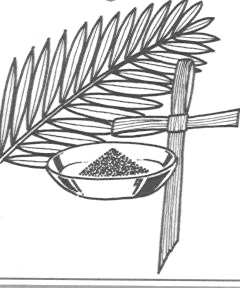
Come mark the beginning of Lent by being marked with the symbol of our mortality and Sin.
Monday, February 23, 2009
Confirmation Retreat Registration

Hey parents and youth. Things are shaping up for us to have a great confirmation class. We'll kick things off with a retreat with many other youth from the area on March 6-7. We'll leave the church at 4:15 on Friday and return here at 9:30pm on Saturday. If you're going, we need a registration form as soon as possible. Print it out here, then drop it by the parsonage or the office. Call Nathan if you have any questions. Thanks!
Transfiguration Sunday Sermon: Out of the Shining of Remembered Days

Transfiguration gives us a template for worship
Important not to try and pitch our tents at one hallowed experience.
He went downhill. There is more to faith than having experiences.
My sermon today has basically been an adaptation from the Interpreter’s Bible Reflection of Halford E. Luccock
Transfiguration may remind us of what worship may mean—a shining hour, high and lifted up, when Jesus and his revelation of God are luminous from within, their own self authenticating evidene, with a glow such as no fuller on earth can supply.
Life’s best hopes and highest aspirations are validated. A poet has written of old age and the “last song” he would make “out of the shining of remembered days.” Worship may be this steady “shining of remembered days,” a sustaining power.
Paul, besides being scourged and imprisoned, remembered in Acts 26, “a light from heaven, brighter than the sun. shining around me, and hearing a voice.”
Does worship have that sustaining power for us? That despite the difficult periods of our lives be reminded of God’s presence and power?
Poem byu Eunice Tietjens,
But I shall go down from this airy place, this swift white peace,
this stinging exultation.
And time will close about me, and my soul stir to the rhythm
of the daily round.
Yet, having known, life will not press so close, and always I shall feel time
ravel thin about me;
For once I stood
In the white windy presence of eternity.
A life which has no transfigured hours of worship is poor, no matter how rich the furniture.
Mountain top experience.
Science and biology attest to something actually happening in our brains when we are truly at worship or at prayer or meditation.
We are given the ability to see beyond or within.
However, this scripture also speaks about the danger implicit in every complete satisfaction. Getting life pegged at that point.
Think of the many areas in which the mood of Peter, when he said in effect “let’s stay here and build,” blocks the possibilities of life.
Always a tragedy when a person moves on everywhere else but leaves his religious thinking behind, pegs his spiritual experience at a point away back in the past.
A life which might have been a voyage of discovery is chained to a spot reached before any genuine exploration could really begin.
Also is sometimes the result of a faith which has refused to grow, and so no longer is able to fit an expanding world of experience and need.
Sometimes underlies that penchant for “the way we’ve always done it.”
It was good for Peter to have the experience, not good for him to try and prolong it. He had to go on to new experiences of understanding and discipleship. The voice said, “Listen to Him!”
((((( Take these words into your imagination. Let them run freely over time and space. Consider how many occasions there have been when the words “This is my beloved son, listen to him” have been and are the supreme wisdom.
When a life looks out on the world in the early years, when it is choosing its goals and its way, its ambitions and aspirations, then listen to him who rejected the proffered kingdoms of this world for the larger kingdom of God.
Many years ago Rudyard Kipling gave an address at McGill University in Montreal. He said one striking thing which deserves to be remembered. Warning the students against an over-concern for money, or position, or glory, he said: “Some day you will meet a man who cares for none of these things. Then you will know how poor you are.
When life goes into eclipse, when darkness covers the face of the sun, in sorrow and failure and despair, then listen to him who was a man of sorrows, and whose revelation of God brings the sustaining word of comfort and the enabling word of hope.
When life waxes in might and gathers power or riches, when the siren song of self-indulgence are sounding, then listen to him who can save life from going to pieces.
Raphael’s picture of the transfiguration. Shows the strking contrast between the mountaintop and what awaits the disciples down the hill. Above, the beauty of that high vidsion; beow, tragic need and suffering, the impotence of the disciples, and the fruitless discussion about it.
We commonly hear the phrase “going downhill” applied to a person in a condemning or pitying manner. When we say someone is “going downhill” we mean that he has seen better days, that he is descending to an anti-climax.
But there is a nobler sense of the words as well—the sense in which Jesus spent his whole life going downhill from the high and lonely places, where he held communion with God, to the level, crowded palaces of human need.
There are those who spend much of their time on the fine art of “going uphill,” climbing to some height of advantage, position, power, or wealth, and pay no attention at all to this much finer art, the art of going downhill. It is the lifelong descent from the place of vision to the place of deed, from the hill of privilege to the plain of need.
This is the trajectory of the life of our savior attested to in the Kenosis passage we read earlier. It is a hymn from our earliest history, and means “emptiness” or “poured out.” Jesus didn’t stop going downhill. He went all the way down the hill through another uphill climb to Golgotha. After dying on the cross, our creed states that he even descended into the land of the dead.
We should glorify this man, because he went all the way downhill for the sake of us. So that we may be lifted up and transfigured along with him.