Sermon Texts:
Jeremiah 1: 4-10
Luke 4: 21-30
For the second week ago, our lectionary reading takes us to this uncomfortable scene in Nazareth. We find Jesus preaching to a rather doting hometown crowd. You can tell that the crowd is impressed with Jesus—“Hey, isn’t that Joseph’s boy?” “Sounds like we’ve got a home-grown Rabbi here!” When Jesus reads the portion from Isaiah, you could hear a pin drop. Luke describes the mood of the room by writing, “The eyes of all in the synagogue were fixed on him.”
When Jesus announces his calling to the life of a prophet by referring to Isaiah and saying “these words have been fulfilled in your hearing,” the place was raucus! People spoke well of him, Luke tells us. We can imagine that the townsfolk might have been clapping each other on the back. “I showed him how to fish!” “I taught him how to read, the old Rabbi may have been thinking to himself—and now look at him! That old stigma that ‘nothing good will ever come out of Nazareth, well we can kiss that goodbye!” They spoke well of him because in doing so they were speaking well of themselves, and everyone likes to do that.
What kind of community does it take to raise a prophet? A minister? This church knows! We have seen members of this community grow into God’s calling on their lives. This church has watched and participated in the growth and maturity of Zach Zink—who is now a minister with young people at a Methodist Church in Paul’s Valley. We celebrate his efforts there, and we pray that his ministry continues to bear fruit as he seeks to walk the path that God is laying before him.
We have seen a ministry bloom here in our midst in the past year and a half with the emergence of our Grief-share ministry. Lives have been touched by the healing presence of Christ through this vital and vibrant ministry.
Tonight you will have the opportunity to come and hear what this group is about. I invite you to be here at 6pm to watch one of the video presentations that introduces us to this ministry. Even if your life has been blessedly free of grief and loss up to this point, as members of the community that has birthed this ministry, we should all be equipped with a little more knowledge than we presently have about how to reach out those who are at a stage of grief that would be fertile ground for an invitation to this group. After a year and a half together, the group has discerned a renewed calling to reach out to those who might receive God’s embrace through this ministry.
Yes, we too are like Nazareth. This church has nurtured the seedbed of God’s activity in our presence. This church has tilled the ground, making it ready for God to plant His calling. This is a reflection on the attentiveness of this community to God’s word and presence.
Things go a little awry in Nazareth though—Jesus seems to pick a fight. Yes, much like the folks in Nazareth, we were probably getting pretty used to the idea that “we” have a lot to do with the ministry that comes out of this church. We like to think of what a great job we do on behalf of God because, well, it makes us look pretty great! Now, as the crowd in Nazareth begins to swell with pride at the marvelous things that this home-boy has accomplished, Jesus sticks a pin in the balloon.
And he said to them, "Doubtless you will quote to me this proverb, 'Physician, heal yourself; what we have heard you did at Caper'na-um, do here also in your own country.'" 4.24 And he said, "Truly, I say to you, no prophet is acceptable in his own country. 4.25 But in truth, I tell you, there were many widows in Israel in the days of Eli'jah, when the heaven was shut up three years and six months, when there came a great famine over all the land; 4.26 and Eli'jah was sent to none of them but only to Zar'ephath, in the land of Sidon, to a woman who was a widow. 4.27 And there were many lepers in Israel in the time of the prophet Eli'sha; and none of them was cleansed, but only Na'aman the Syrian." 4.28 When they heard this, all in the synagogue were filled with wrath. 4.29 And they rose up and put him out of the city, and led him to the brow of the hill on which their city was built, that they might throw him down headlong. 4.30 But passing through the midst of them he went away.
Hmmm….. It doesn’t feel so great to be Nazareth after all, does it? Jesus seems to instigate this fight. He breaks one of the cardinal rules of marriage counselors everywhere—he puts words in their mouth—he tells them what they are feeling. But, this is Jesus, after all. Unlike us, Jesus can see into the deepest darkest shadows of our hearts and egos, even when we are turning the blinding light of our pride and exultation in his face.
Jesus speaking about a prophet not being accepted in his own home town is not just a unique critique of Nazareth though, it is something core in our human natures. We can’t accept the prophets that we raise. They may be accepted elsewhere—they may turn eyes toward God in neighboring communities, but the scriptures say that even Jesus could not work miracles in his hometown of Nazareth—because the people there lacked faith. We have too much invested in our home town prophets to be able to see that it is God’s grace that shines forth from them. Jethro may have taught Jesus how to fish when he was 6 years old, but it is God who is fishing through Jesus now! We have a hard time separating our heritage passed on from God’s activity at work through the lives of those in ministry.
And what is it that Jesus references to seemingly prove this point? He points what he predicts will be their eagerness to see miracles and healings worked among them, and then gives them a history lesson. Will Willimon writes, “Luke wants it understood: The problem with Jesus is not between the new and the old, between the known and the unknown, but between the people of God and their own memory. Between the known and the known. Jesus, hometown boy, Joe and Mary’s son, addressed Israel from her own scripture, her own past, her own authoritative texts, the familiar prophets, a text they already knew. “The Day of the Lord is here!” he announced. “Amen!” they shouted. There was an excited stirring among the Chosen People at Nazareth. “Amen!” All of our waiting for deliverance, is over at last. The Lord is coming! At last he is coming to redeem his own! People lifted up on their crutches, old men wept for joy, the oppressed raised their faces filled with hopeful expectation. “Amen!” “Now, when the Lord came earlier, as I recall, there were lots of poor hungry women in Israel, but God chose to help a foreign widow, instead. You know that story.” says Jesus. There was silence. “And speaking of old, familiar stories,” continued Jesus, “You all remember the one about how Elisha healed an army officer, a Syrian — rather than all those poor deserving lepers in Israel.” And you could cut the congregational silence with a knife.. When the Lord came to deliver us, Jesus says, remember that he came to human need beyond the bounds of the Chosen. It’s in the Bible, Jesus said. You know the story of Isaiah, Elijah, Elisha. And a chorus of “Amens” becomes a thunder of silence. It is the silence of judgment, when an exciting, new sermon suddenly becomes recognized as an old story we already know and wish to God we could forget. Proximity to and familiarity with the persons and texts God chooses is a privilege that also blinds, dulls, impedes. Isn’t this the carpenter’s son? We know him. “Yes” says Jesus continuing the sermon, “pagan Ninevah will get to judge this place because Ninevah repented when Jonah preached to them. The Queen of Sheba went across the world to hear Solomon, and yet, here among you is one greater their either Jonah or Solomon. (Luke 11) At the judgment, you will claim your privilege as free passes, recalling the evening you had dinner with Jesus or when he preached in your town (Luke 13:26-27), My family founded this church. I have been in this congregation my whole life. But to no avail. Judgment begins with God’s own house.”
Sometimes it is difficult to hear God’s plans. There might be a moment of clarity, a moment of the Spirit brushing past us—but then the waters might seemingly be muddied—but hold on God, that’s not what I want! That’s not what I need! That’s not how you’re supposed to be, God.
So, we’ve wondered what kind of community it takes to raise a prophet: What kind of community does it take to reject a prophet? The answer is—the same kind of community that raises a prophet! It may be our community. It may be God’s chosen city on a hill!
That is how our story ends today—we hear that the townspeople are so angered by the words that Jesus has spoken, they are so filled with rage as Luke tells it, that they drive Jesus to the edge of a cliff so that they might cast him off of it. Why are they so enraged? Because Jesus reminded them of what they already knew—that God cannot be bound by our feeble imaginations and our inability to conceive worth and preciousness in those who are radically different from us.
But there is hope for us yet-- Thanks to the story of Jesus’ own rejection, we have the opportunity to listen to the prophets in our midst. Or, if nothing else, we have the opportunity to let these prophets pass through us, as Jesus is shown going on his way even though Nazareth would like to drive him to the edge of a cliff. We have the opportunity to let Jesus pass through our midst—and even if we are too stubborn to hear what he has to say, even if we aren’t at the point where we can let him change us, if we only step out of the way and let him through—he can go on to others who are ready to heed his call. By letting him walk through us, Christ will walk…through us. Sometimes it simply takes a letting go of what we expect from Jesus for us to begin being used by Jesus. As the saying goes, “Let go and let God.”
So tonight, you have the opportunity to step aside and let Jesus through the crowd. We host a ministry of Christ in a particular way. It isn’t the only ministry of our congregation, but it is one that has borne fruit and is ready for new growth. Christ has empowered those in the group who feel that calling to a ministry that is needed and is heard about from Okemah to Muskogee. God is blessing those who may not come from our particular community. But as Jesus told those at Nazareth, this is our heritage! God is bigger, and works in ways that always stretch the boundaries that we tend to put up around us. When God knocks down those boundaries, we feel uncomfortable—but if we make the decision to live in our boundary-less world in God’s presence, we have nothing to fear!
So, come tonight so that you can share in this particular ministry—perhaps you have nothing personally to gain—but perhaps God will work through you to bring someone else to this ministry! Or, perhaps God is calling you to participate in a community of sharing loss and grief. We never know unless we put it in God’s hands.
Another thing we might do is write a note of encouragement or appreciation to Zach—a person who has devoted his livelihood to ministry with young people. He may no longer be in ministry to our community, but God has empowered him through his experience in this church. We have God to thank for the ministry that Zach is sharing with our young brothers and sisters in Paul’s Valley.
If nothing else, think twice before joining the crowd on the figurative “cliff.” We have not stopped killing our prophets! God can and does use those whom we least expect. Open your hearts to the possibility that God might want to use you—or your enemy. Or perhaps Jesus just needs you to step aside and let him through.

Sunday, January 28, 2007

Tuesday, January 23, 2007
"Breaking the Code" Bible Study on the Book of Revelation Begins Wednesday

Wednesday evening at 6pm we will begin a journey into perhaps one of the most mysterious books of the Bible--The Book of Revelation. Each session will include a video presentation from an expert on the scriptures, Bruce Metzger. Metzger is the chief editor of the New Revised Standard Version of the Bible and a distinguished professor emeritus of Scripture at Princeton University. As important as our guidance by Metzger will be the fun and fellowship of discovering this book's secrets and messages together in a group of around 20 people. If you would like to attend, you are welcome. The book we will use together costs $8. Hope to see you there!
Monday, January 22, 2007
Rest In Peace Jerry

Our thoughts and prayers are with the Holland family as they mourn the loss of Jerry: husband, father, grandfather, friend. The funeral will be held Wednesday at 10:30 at Morris United Methodist Church. Burial will be at Council Hill. There will be a viewing at Okmulgee McClendon-Winters Funeral Home on Tuesday night from 6-8pm for family and friends.
Sermon for Jan 21, Epiphany 3: Preaching What Jesus Preached
Scriptures:
Psalm 19
Luke 4: 14-21
We like to hear nice things, don’t we? We love to hear that Jesus loves us no matter who we are or what we’ve done. We prefer our Jesus smiling and courteous and compassionate. Tell me the stories of Jesus, I love to hear, we sing. What about the stories of Jesus getting thrown out of his hometown? What about the stories of Jesus saying things that when we really think about it, well, they’re pretty revolutionary?
Now, I’m not doubting that everyone in this church building loves Jesus—that is clear by the ministry that this church does in this community. That is clear by how we work and play and pray and study the Bible together. Please don’t get me wrong! But while I’m not doubting that we all love Jesus, I’m betting that we also love something called the status quo. The status quo is “the way things are,” and its generally loved and fiercely protected by those who have things relatively good—who are relatively comfortable.
Now, there’s nothing wrong with that—we want to preserve things when they are going well—if I’ve got a way of preparing a sermon through the week that works and it allows me plenty of time to address the other needs of being a minister to this church, I’m probably going to stick with it—it works after all! Likewise, if we’ve got a system of orienting our place in the world that has generally been good for us thus far in life, who’s going to blame us for sticking with it?
But when it comes to Jesus and when it comes to faith and when it comes to being the church—the status quo is sometimes not good enough. You see—we are adaptive creatures of habit. When we get comfortable, we tend to settle in and focus on what’s in front of us. We’re like horses with those blinders on that only allow us to see strait forward—you know the kind that pull carriages through the park or the kind that police ride through the city. You know why they wear those blinders, right? Because if they see all the activity and goings on all around them, they’ll get kind of freaked out! No, better keep their focus straight ahead so that the policeman on the horse’s back or the guy driving the carriage can retain control of the horse.
Yes—we get in a nice spot, a status quo, and we may not realize it, we probably don’t make the choice to do it ourselves, but some way or another we get the blinders put on and we don’t see the ugly things in the world around us that might cause us to get freaked out!
In our faith life, we might just say something like—“Well, just focus on Jesus, just put your mind on him and everything will be okay!” We might say, “Turn your eyes upon Jesus, look full in his wonderful face, and the things of earth will grow strangely dim in the light of his glory and grace.” Hmmm……
Now, once again, don’t get me wrong—I don’t want to get thrown out of town, like Jesus did! But I do want to speak what I hear the Spirit stirring me to speak! Focusing on Jesus while the world around us fades is a great remedy for us to deal with hardship and struggle that may face us in life—it takes a lot of faith to put the world aside and “turn our eyes upon Jesus.” I don’t want you to think I am criticizing that aspect of faith. But I want you to know how this same resource for strength can also be a sedative if used inappropriately.
A pastor I’ve been reading from over the past few weeks said the following, and it was convicting to me. “Like a lot of mainline preachers, I’m so mindful of the bottom line that I have hedged the prophetic voice. It has been easier, more acceptable, to preach Jesus rather than what Jesus preached.” To preach Jesus rather than what Jesus preached—did you hear that?
It is easier for us to hear about Jesus and his unequivocal promise of love for us than for us to hear what Jesus preached, which was not only his love for us, but his love for the least of us. He also preached peace, and economic justice, and forgiveness. It is easier for us to hear “come to me all who are weary and carrying heavy burdens and I will give you rest—for my burden is easy and my yoke is light” than “The Spirit of the Lord is upon me, because he has anointed me to bring good news to the poor. He has sent me to proclaim release to the captives and recovery of sight to the blind, to let the oppressed go free, 19to proclaim the year of the Lord’s favor.”
We can imagine what release to the captives might look like, right? What would that mean in our society? Good news to the poor—what would that good news be? Letting the oppressed go free—I that would upset the status quo, don’t you?
The year of the Lord’s favor—sounds like a nice year, right? What Jesus is there referring to is the year of the Jubilee, when all debts were periodically forgiven and the slate was wiped clean. Some of us got really excited around the turn of the millennium and tried to encourage our government and other rich nations to proclaim a jubilee for the poorest nations who owe insurmountable debts to the governments of nations which are currently keeping our national boots on their necks. The idea was that many of these countries would be able to divert money owed to foreign governments like ours and Britain into health and education programs. Some of the campaigning worked, some if it lost momentum by 2001.
If anything disrupted a status quo, it would be the year of the Jubilee! I imagine we like the way things are because it’s safe—it’s what we know! We accept our blinders and move in the direction we are guided in. But let me ask you a question—when we so willingly wear those blinders, when we just shuffle in the way our reigns are guiding us, do we ever stop to think of who it is on our back? Who, or what is guiding us when we put on those blinders to the reality that the world around us isn’t all warm and lovable and ordered.
If we took off those blinders, if I began to preach what Jesus preached, I’d probably be reminding us each week that of the estimated 3.5 homeless people in America today, 40% are children. And that is in America, where children in homelessness is fairly low! If I had the courage to preach what Jesus preached and not just preach Jesus loves me, this I know, I’d probably frequently ask us to remember the victims of the AIDs pandemic—the 36.2 million people living with AIDS in the world today, the 15.2 million AIDS orphans, I might ask us to at least question the policymakers and elected officials who apply 50 cents of every tax dollar I spend to the military budgets that keep climbing and climbing, and yet can’t seem to provide adequate health insurance for the families of servicemen and women.
Fifty cents for every tax dollar goes for the current military budget and back pay for past wars and military engagements! And that doesn’t even include what is budgeted for the CIA, the NSA or any other of our secret agencies—their budget amounts are classified! That also doesn’t include the $380 billion dollars in unbudgeted requests by the military that have been repeatedly approved year after year because none of our elected officials want to come across to all of us as being “unpatriotic!”
So why did I get off on this tangent? Because I want you to hear that holiness is not just personal spirituality—it is social spirituality. It is an ethic of living in the world without blinders on! It is about believing not just in Jesus but in what Jesus preached! Jesus preached a devout personal holiness, the good news of God’s love for the individual person—and he also preached social holiness, the good news of God’s plan for God’s kingdom and our role in that kingdom. The awakening to our adoption by God is a part of the fulfillment of that kingdom—but so is release to the captives, so is recovery of sight to the blind, so is freedom for the oppressed.
Look at your hymnals—go to your table of contents. You see there on page ix, under Sanctifying and Perfecting grace? That is the third part of our threefold Wesleyan understanding of grace. You see some hymns are related to personal holiness and some hymns are related to social holiness? That’s because Wesley, the founder of Methodism believed and our heritage is that there is no personal holiness without a social expression of that holiness, and there is no social holiness without a personal holiness! Holiness means right living, it is the experience of sanctifying grace—that grace that leads us toward our intended natures.
“Preaching Jesus” could be translated as “personal holiness” while preaching what Jesus preached could be translated as “social holiness.” We have to be mindful of both—we must celebrate both in order to live up to the great example that has been set for us in the life of Jesus.
Lawrence Wood concludes his article about today’s scriptures by referencing the Psalm that we heard—he writes, “Maybe the ‘heavens are telling the glory of God’ because they are above mere politics and can put truth and justice in something other than a partisan perspective. Or perhaps they have resolved not to wait. In any event, the heavens are doing their part; they ask us to join in the telling.”
Yes! Taking off the blinders is saying loud and clear that we believe God can and must be glorified even in the face of the darkness in this world. We mirror the magnificent expansive circuit of the sun when our view of our surroundings is not narrowed by what we choose and choose not to pay attention to. The harsh realities we may discover are not evidence for hopelessness, they are promptings share God’s good news! Put your trust in the truth of God’s presence, and the darkness of the world will come to light, in the “light of his glory and grace.” Amen
Psalm 19
Luke 4: 14-21
We like to hear nice things, don’t we? We love to hear that Jesus loves us no matter who we are or what we’ve done. We prefer our Jesus smiling and courteous and compassionate. Tell me the stories of Jesus, I love to hear, we sing. What about the stories of Jesus getting thrown out of his hometown? What about the stories of Jesus saying things that when we really think about it, well, they’re pretty revolutionary?
Now, I’m not doubting that everyone in this church building loves Jesus—that is clear by the ministry that this church does in this community. That is clear by how we work and play and pray and study the Bible together. Please don’t get me wrong! But while I’m not doubting that we all love Jesus, I’m betting that we also love something called the status quo. The status quo is “the way things are,” and its generally loved and fiercely protected by those who have things relatively good—who are relatively comfortable.
Now, there’s nothing wrong with that—we want to preserve things when they are going well—if I’ve got a way of preparing a sermon through the week that works and it allows me plenty of time to address the other needs of being a minister to this church, I’m probably going to stick with it—it works after all! Likewise, if we’ve got a system of orienting our place in the world that has generally been good for us thus far in life, who’s going to blame us for sticking with it?
But when it comes to Jesus and when it comes to faith and when it comes to being the church—the status quo is sometimes not good enough. You see—we are adaptive creatures of habit. When we get comfortable, we tend to settle in and focus on what’s in front of us. We’re like horses with those blinders on that only allow us to see strait forward—you know the kind that pull carriages through the park or the kind that police ride through the city. You know why they wear those blinders, right? Because if they see all the activity and goings on all around them, they’ll get kind of freaked out! No, better keep their focus straight ahead so that the policeman on the horse’s back or the guy driving the carriage can retain control of the horse.
Yes—we get in a nice spot, a status quo, and we may not realize it, we probably don’t make the choice to do it ourselves, but some way or another we get the blinders put on and we don’t see the ugly things in the world around us that might cause us to get freaked out!
In our faith life, we might just say something like—“Well, just focus on Jesus, just put your mind on him and everything will be okay!” We might say, “Turn your eyes upon Jesus, look full in his wonderful face, and the things of earth will grow strangely dim in the light of his glory and grace.” Hmmm……
Now, once again, don’t get me wrong—I don’t want to get thrown out of town, like Jesus did! But I do want to speak what I hear the Spirit stirring me to speak! Focusing on Jesus while the world around us fades is a great remedy for us to deal with hardship and struggle that may face us in life—it takes a lot of faith to put the world aside and “turn our eyes upon Jesus.” I don’t want you to think I am criticizing that aspect of faith. But I want you to know how this same resource for strength can also be a sedative if used inappropriately.
A pastor I’ve been reading from over the past few weeks said the following, and it was convicting to me. “Like a lot of mainline preachers, I’m so mindful of the bottom line that I have hedged the prophetic voice. It has been easier, more acceptable, to preach Jesus rather than what Jesus preached.” To preach Jesus rather than what Jesus preached—did you hear that?
It is easier for us to hear about Jesus and his unequivocal promise of love for us than for us to hear what Jesus preached, which was not only his love for us, but his love for the least of us. He also preached peace, and economic justice, and forgiveness. It is easier for us to hear “come to me all who are weary and carrying heavy burdens and I will give you rest—for my burden is easy and my yoke is light” than “The Spirit of the Lord is upon me, because he has anointed me to bring good news to the poor. He has sent me to proclaim release to the captives and recovery of sight to the blind, to let the oppressed go free, 19to proclaim the year of the Lord’s favor.”
We can imagine what release to the captives might look like, right? What would that mean in our society? Good news to the poor—what would that good news be? Letting the oppressed go free—I that would upset the status quo, don’t you?
The year of the Lord’s favor—sounds like a nice year, right? What Jesus is there referring to is the year of the Jubilee, when all debts were periodically forgiven and the slate was wiped clean. Some of us got really excited around the turn of the millennium and tried to encourage our government and other rich nations to proclaim a jubilee for the poorest nations who owe insurmountable debts to the governments of nations which are currently keeping our national boots on their necks. The idea was that many of these countries would be able to divert money owed to foreign governments like ours and Britain into health and education programs. Some of the campaigning worked, some if it lost momentum by 2001.
If anything disrupted a status quo, it would be the year of the Jubilee! I imagine we like the way things are because it’s safe—it’s what we know! We accept our blinders and move in the direction we are guided in. But let me ask you a question—when we so willingly wear those blinders, when we just shuffle in the way our reigns are guiding us, do we ever stop to think of who it is on our back? Who, or what is guiding us when we put on those blinders to the reality that the world around us isn’t all warm and lovable and ordered.
If we took off those blinders, if I began to preach what Jesus preached, I’d probably be reminding us each week that of the estimated 3.5 homeless people in America today, 40% are children. And that is in America, where children in homelessness is fairly low! If I had the courage to preach what Jesus preached and not just preach Jesus loves me, this I know, I’d probably frequently ask us to remember the victims of the AIDs pandemic—the 36.2 million people living with AIDS in the world today, the 15.2 million AIDS orphans, I might ask us to at least question the policymakers and elected officials who apply 50 cents of every tax dollar I spend to the military budgets that keep climbing and climbing, and yet can’t seem to provide adequate health insurance for the families of servicemen and women.
Fifty cents for every tax dollar goes for the current military budget and back pay for past wars and military engagements! And that doesn’t even include what is budgeted for the CIA, the NSA or any other of our secret agencies—their budget amounts are classified! That also doesn’t include the $380 billion dollars in unbudgeted requests by the military that have been repeatedly approved year after year because none of our elected officials want to come across to all of us as being “unpatriotic!”
So why did I get off on this tangent? Because I want you to hear that holiness is not just personal spirituality—it is social spirituality. It is an ethic of living in the world without blinders on! It is about believing not just in Jesus but in what Jesus preached! Jesus preached a devout personal holiness, the good news of God’s love for the individual person—and he also preached social holiness, the good news of God’s plan for God’s kingdom and our role in that kingdom. The awakening to our adoption by God is a part of the fulfillment of that kingdom—but so is release to the captives, so is recovery of sight to the blind, so is freedom for the oppressed.
Look at your hymnals—go to your table of contents. You see there on page ix, under Sanctifying and Perfecting grace? That is the third part of our threefold Wesleyan understanding of grace. You see some hymns are related to personal holiness and some hymns are related to social holiness? That’s because Wesley, the founder of Methodism believed and our heritage is that there is no personal holiness without a social expression of that holiness, and there is no social holiness without a personal holiness! Holiness means right living, it is the experience of sanctifying grace—that grace that leads us toward our intended natures.
“Preaching Jesus” could be translated as “personal holiness” while preaching what Jesus preached could be translated as “social holiness.” We have to be mindful of both—we must celebrate both in order to live up to the great example that has been set for us in the life of Jesus.
Lawrence Wood concludes his article about today’s scriptures by referencing the Psalm that we heard—he writes, “Maybe the ‘heavens are telling the glory of God’ because they are above mere politics and can put truth and justice in something other than a partisan perspective. Or perhaps they have resolved not to wait. In any event, the heavens are doing their part; they ask us to join in the telling.”
Yes! Taking off the blinders is saying loud and clear that we believe God can and must be glorified even in the face of the darkness in this world. We mirror the magnificent expansive circuit of the sun when our view of our surroundings is not narrowed by what we choose and choose not to pay attention to. The harsh realities we may discover are not evidence for hopelessness, they are promptings share God’s good news! Put your trust in the truth of God’s presence, and the darkness of the world will come to light, in the “light of his glory and grace.” Amen
Sunday, January 14, 2007
Jan 14 Sermon, Baptism of our Lord Sunday, Who are We?
Scriptures:
Who are we?
I’ve been thinking about identity a lot lately. It has occurred to me that it is the focus, and perhaps the obsession, of my generation. A couple of months ago, at a meeting with the Oklahoma Young Adult Council of which I am a part, we were asked by a program director at the Board of Discipleship to create a T-shirt that spoke to or about young adults. I designed a trendy “message shirt” you know the kind—they have some simple statement in bold letters on a shirt. Something like “Princess” or “Spoiled” or “Loves His Mama.” The t-shirt I created simply said, “Who Am I?”
It seems that our current consumer market is aggressively oriented toward giving us the answer to just that question—or perhaps more positively, creating an opportunity for us to answer that question for ourselves. Hours on a website called “Myspace” gives me the opportunity to tailor a website to my specifications. What is the website about? Well, quite simply, it is about “ME!” My friends are arranged together (perhaps in order of preference,) my favorite bands are catalogued and displayed. (One of my friends –actually he’s only an acquaintance that I met by surfing around to see what the Wesley Mattoxes of the world were like.) This guy and I are so similar that I’m sure we have to be related. His ancestors are from Georgia and South Carolina, just like mine—we seem to share the same quirky sense of humor, and he is an archaeologist—who hunts for Pirate ships--my boyhood dream job.) Anyway, Wesley Mattox has in his music column. “I used to have a bunch of bands here that you’ve never heard of to show you how cool I am—now I have nothing here, and I’m still cooler than you are.”
I believe that obsession with identity is my generation’s collective response to the age of information. A couple weeks ago, I found in my mailbox that I was named Time’s “Person of the Year!” Were you aware of this?! Instead of actually choosing someone to give this distinction to this year, Time’s editors decided that we all deserved a shot, with all the youtubing and blogging and internet evolving that we’ve all been up to over the past year. Several of the stars of the second wave internet revolution are profiled in the magazine, including Tila Tequila, who has been quite successful at “selling herself” to a friend network of over 2 million people, is quoted as saying, “This is my job, That’s how you maintain your popularity and keep it alive.”
In this special issue of Time, Joel Stein explores the freedom and fun of creating an alter-ego on the website “Second Life” where you appear custom made by you in a virtual world of parties, dating, and whatever else comes to mind.
Now, before I begin sounding judgmental about various computer programs that I myself spend time on, I want to point out that these internet tools are indicative of a deep desire to be someone—to say to the world, “this is who I am!” Unfortunately, many in our midst have become so dissatisfied with real existence and uninterested in the world around them that they choose the “cyber” world over their actual flesh and blood identity.
Into all this self-obsession with identity, Jeremiah inserts a word or two—You heard it this morning… So I went down to the potter's house, and there he was working at his wheel. 4 The vessel he was making of clay was spoiled in the potter's hand, and he reworked it into another vessel, as seemed good to him. 5 Then the word of the Lord came to me: 6 Can I not do with you, O house of Israel, just as this potter has done? says the Lord. Just like the clay in the potter's hand, so are you in my hand, O house of Israel.”
It seems to me that God is the one that gives us our ultimate identity. All this dwelling on the self may in fact be distracting us from the new creation that God is making out of me! I think I know who I am, but God proclaims to Jeremiah and us— "Before I formed you in the womb I knew you, and before you were born I consecrated you; I appointed you a prophet to the nations."
God lets Jeremiah in on this as he struggles with his own identity. He thinks he is too young to live the life toward which God is calling him. In the narrative that surrounds the prophetic words of Jeremiah, we learn that he submits his own identity to that which God has given him.
We need to make ourselves soft clay, so that the potter’s hands have a chance to mold us so that we can be filled with the fountain of the Holy Spirit. “Melt me, Mold me, Fill me, use me!” is the phrase that we sang last week when installing our church leaders.
Into the world that tries to sell us the idea that our identity can be bought and sold, God lays claim to us. We heard it said in the story of Jesus’ baptism—“This is my beloved child, in whom I am well pleased.”
How do we know what we believe if we don’t practice saying it? Words are something that have the power to form us. If we are told over and over again that we are loved—we might just begin to actually believe it. But how do we hear the voice of God today? At Jesus’ baptism, we are told that a voice from heaven declared, “This is my beloved child, with whom I am well pleased.” John the evangelist tells us that through Christ, God makes the same claim on us—but how do we hear it? Not many of us have heard disembodied voice from heaven or the presence of God descending like a dove.
Lawrence Wood, a UM pastor in Michigan, related the following story about a friend of his who struggled to hear and believe God’s word. He writes, “A medical doctor once told me how he had fought against the idea of a personal God who intervened in human life. HE sought refuge instead in music; Bach particularly appealed to him because of the mathematical precision of the fugues. Meanwhile, his life was falling apart. His first wife left him; he started drinking too much. One day as he was driving, he pounded the steering wheel with his open palms and cried out, “God, if you’re really there, you’re going to have to say something! And you know what kind of man I am! No screwing around! You’re going to have to talk my language!” Just then on the radio came Jesu, Joy of Man’s Desiring.” My friend sobbed, and laughed at what an idiotic but wonderful word this was to him. And just in case he might try to explain away the moment, saying that Bach was often played on the radio station (actually a nonclassical music station), the next song to come was “The Girl from Ipanema.”
God does speak to us in uncanny moments, telling us we are beloved children and using our own names. Perhaps we’re not used to recognizing that voice in a sacramental world. Our radios seem to be on a wavelength different from God’s kind of broadcasting. And if we cannot hear God, then we will not trust God to do anything of consequence. We will believe only in a remote, ineffectual, impersonal process, rather than a powerful, demanding, loving force. If we want to hear something more direct, we need to come to the baptismal waters, dip our hands in and awaken our senses.
So this morning when we are few in number, I would invite you to come and place your hands in the Baptismal waters. This is our sacred symbol of God’s claim on our life—the claim that is nurtured by being part of a community of believers. If you have not been baptized, please let me know that. Not so I can rank us according to “saved” and “unsaved,” but instead so I as your pastor can be more aware of your own spiritual journey. Our new system of membership record asks that we keep this information on record so that our journey, and not just our name, birth, and death date might be preserved in the collective memory of this church.
Sunday, January 07, 2007
Sharing Griefshare--UPDATED, Jan 13
DUE TO THE ICY WEATHER, WE'RE GOING TO HAVE TO POSTPONE THIS OPPORTUNITY TO LEARN MORE ABOUT GRIEFSHARE TO JAN. 28 AT 6PM.
STAY SAFE THIS WEEKEND!
Our church is blessed to have a group meeting in our building that has reached out and changed lives among members of our community. Now we have the opportunity to help this group further reach out.
It is very uncommon to live a life untouched by the grief of a lost loved one or a lost relationship. Sometimes we experience grief simply by moving to a new home. Though grief is almost universally experienced, it is not experienced in the same way for any two people. Many of us aren't quite sure how to handle someone who has experienced loss. We hope they will just soon "get over it," or "move on" so that we may be more comfortable around them.
The Griefshare group that meets at our church every Sunday night at 5pm has moved into a new phase in their collective experience. They have shared with one another now for over a year, and are ready to be a ministry for others in the community who have not had the opportunity to share their burden of grief with anyone else. We in the church know people who have experienced loss, but may be unfamiliar or uncomfortable with a way to invite them to consider processing their grief in fellowship. This group has such powerful potential. There is nothing like it in a 25 mile radius of Morris, and people come from communities like Henryetta and Okmulgee to attend at OUR church. The funeral homes in our area know about this ministry, and pass the word along to people of all denominations who they feel might benefit from the power of community.
So that we all are able to be more knowledgeable about this program, its function, and process, I'd like all who can attend to come to church on January 28TH at 6pm to view a brief video from the group's new curriculum. I'll be there to help you think of ways to broach the subject with people who have experienced loss. (Just a hint--in case you can't make it, it's best to make an invitation no sooner than 3-4 months after someone has experienced that loss, since for the first few months the person is usually in "shock" from the loss and is less likely to benefit from a shared group experience.)
Christ promised us that we could "come to him with our heavey burdens, and he would give us rest, because his burden is easy and his yoke is light." (Mt. 11:28) He also promised us that "whereever two or more are gathered in my name, I am there among them." (Mt. 18:20). We have a great opportunity to bring people to healing by offering this ministry! Thanks to all in the group who participate, and may we do what we can to support Christ's ministry through this community.
STAY SAFE THIS WEEKEND!
Our church is blessed to have a group meeting in our building that has reached out and changed lives among members of our community. Now we have the opportunity to help this group further reach out.
It is very uncommon to live a life untouched by the grief of a lost loved one or a lost relationship. Sometimes we experience grief simply by moving to a new home. Though grief is almost universally experienced, it is not experienced in the same way for any two people. Many of us aren't quite sure how to handle someone who has experienced loss. We hope they will just soon "get over it," or "move on" so that we may be more comfortable around them.
The Griefshare group that meets at our church every Sunday night at 5pm has moved into a new phase in their collective experience. They have shared with one another now for over a year, and are ready to be a ministry for others in the community who have not had the opportunity to share their burden of grief with anyone else. We in the church know people who have experienced loss, but may be unfamiliar or uncomfortable with a way to invite them to consider processing their grief in fellowship. This group has such powerful potential. There is nothing like it in a 25 mile radius of Morris, and people come from communities like Henryetta and Okmulgee to attend at OUR church. The funeral homes in our area know about this ministry, and pass the word along to people of all denominations who they feel might benefit from the power of community.
So that we all are able to be more knowledgeable about this program, its function, and process, I'd like all who can attend to come to church on January 28TH at 6pm to view a brief video from the group's new curriculum. I'll be there to help you think of ways to broach the subject with people who have experienced loss. (Just a hint--in case you can't make it, it's best to make an invitation no sooner than 3-4 months after someone has experienced that loss, since for the first few months the person is usually in "shock" from the loss and is less likely to benefit from a shared group experience.)
Christ promised us that we could "come to him with our heavey burdens, and he would give us rest, because his burden is easy and his yoke is light." (Mt. 11:28) He also promised us that "whereever two or more are gathered in my name, I am there among them." (Mt. 18:20). We have a great opportunity to bring people to healing by offering this ministry! Thanks to all in the group who participate, and may we do what we can to support Christ's ministry through this community.
Epiphany Sermon--Star of Wonder
For the content of this sermon, I am heavily indebted to a sermon titled "Another Way Home" by Rev. Harry Pritchett. Though I don't make a practice of "lifting" someone else's work, what I wanted to say in this sermon had simply already been said by someone else about 10 years ago--so enjoy my slightly altered version of Rev. Pritchett's original (which can be found on the Day 1 website.)
Sermon Text:
Isaiah 60: 1-6
Luke 2: 1-12
Did you ever think about what happened to the Wise Men when they went back home? Did they live happily ever after? Were their lives changed?
After the shimmering splendor of the star's light and the wonder and mystery of having now, at last, peered into the center of their hearts' desire ... after all that, did it make a difference back home on the mundane Monday morning of taking out the garbage, and changing the diapers, and balancing the checkbook, and paying the bills, and attending the meetings, and feeding the livestock, and figuring out the taxes, and calling on the clients, and getting their teeth filled, and planning the birthday party, and all the thousand and one things that it takes to live?
After all, the Wise Men had followed a star, and were exceedingly joyful in their journey's end. But was it really their journey's end, since it was necessary for them to return to their own country? They did not remain in the "royal beauty bright" of the star, but being warned in a dream of Herod's deadly intentions, they returned to their homes by another way. But what was life like for them afterwards? After the star, in the cold light of day, did it all really matter?
After the anticipation and the celebration and the wonder of the holy night with the candles flickering and the smell of cedar and the songs of angels, does the spirit of Christmas burn away like the morning fog? When it's time to drag out the tree and to straighten up the house and to get back to school and return to work, are we not like the Wise Men going back home to their own country?
In his poem "For the Time Being," W. H. Auden describes this post-Christmas mood "Well, so that is that ... we've gotten through Christmas once again, perhaps in spite of ourselves...but it's over now.
"Once again as in previous years we have seen the actual Vision and failed to do more than entertain it as an agreeable possibility. So, it's back to the old world we left behind for just a bit on Christmas Eve, and perhaps that makes us weary. And yet the Vision will not entirely go away. We almost wish it would." Auden concludes, "To those who have seen the child, however dimly, however incredulously, the time being is, in a sense, the most trying time of all."
What Auden describes is more subtle ... more profound than what is popularly referred to as the after Christmas blues. Like the Wise Men, for those who have seen the star, it will not easily fade away. The sense of wonder, the capacity to dream, the joy, the joy of that holy night continues to catch our imagination. We still long to know it right here in the midst of the old routines, right here where we are and always have been ... in a world that Christmas doesn't seem to have changed very much.
Could it be that our world is really Herod's world ... the Roman world ... rather than the mysterious eastern world of the Wise Men? Are we not more children of Herod than descendants of those starry-eyed star gazers? Do we not seek order, decency, efficiency, control, rather than the unclear, vague, formless mystical naiveite of the Wise Men?
I believe we live today in a world from which almost all of the wonder has been drained away. One night this week, I gave Wesley a bubble bath, and eventually all the bubbles popped and disappeared. I hadn’t noticed, and neither did Wesley, until it seemed to register to him, and he looked around in the tub and didn’t see any more bright shiney bubbles, and looked up at me with furrowed brow and arms in the air—“Bubbles?” He asked. “They’ve all popped, son—Bubbles are all gone!”
We tend to see religion as only a system of "rights and wrongs," or as a pattern of engaging in worship. We tend to have insulated and isolated ourselves from wonder ... from imagination ... from mystery ... because it is unmanageable, impractical, and finally useless. What good do those bubbles in the bubble bath do anyway?!
But I believe it is precisely that wonder for which human hunger cries out today. In the midst of our technological and mechanical and scientific world, I find my soul unsatisfied and my heart yearning for something more. Don't you? I experience it all around me. Some people flee to Eastern gurus or modern, new age spirituality. Fantasy literature and movies have become a major component of our entertainment. We hunger and we long for mystery. We wish and yearn for that which is greater than ourselves, for that which outreaches our human grasp, for affiliation with something that transcends the horrors which technology has given us under the false promise of salvation.
We experience the moral poverty of almost all political and social and economic systems. We watch powerless as international violence and terrorism explode across our lives, We hear the macho game-playing of our leaders under the giant shadow of war and rumors of war. And we sense that the world is out of control, reeling toward some hideous nightmare end ... nuclear or toxic. And we know that we must reach beyond this world for anything approximating hope. And beyond this world, there is only the mystery, the wonder, the stars.
It was Albert Einstein who said, "The most beautiful thing we can experience is the mysterious." And it is that mystery, that wonder, that capacity to dream that we celebrate through the story of the Wise Men at Epiphany. It is the awesome light that the Wise Men were shown that transcends all order, all ethics, all understanding.
So what shall we do? Being warned in a dream, the wise men decided to go back home another way, and so can we. We can resist the Herods of our time who try to trick us into the subtle cynicism of believing that wonder and dreams and imagination are the venues of children alone and not for so-called grown up, practical men and women. Contemporary Herods may be very smart, but they will not be very wise.
Contemporary Herods are all those people, institutions, and cultural assumptions that kill the childlike wonder in us all. Herods inside or outside us always say ... "It can't be done ... there is no way ... you must never take a chance ... everything you do must be useful and efficient ... imagination is worth nothing ... playing is wasteful ... do not follow stars." To help you develop your wisdom you might just begin by doing something very simple ... not grand.
For instance you might buy some watercolors and paint a picture, you might sit on the porch and watch the bare trees become ablaze with the sunset. Or you might read a poem or sit and listen to a song, or you might add a few things to the recipe, or you might look much longer than usual at your face in a mirror, not to shave, or put on makeup or do anything other than ponder the mystery of yourself. Or you might write down every question you ever had or were afraid to let yourself even ask, not to search for answers, but to live the mystery of the questions, or you might get a copy of the photograph of the earth ... taken from the moon and wonder at our place in the universe.
In short, we can decide to pay more attention to all of life. We can decide to listen more to the silence. We can decide not to be so hurried, and so closed and so secular, that we do not even see the star ... the star shining in the face of our own children ... the star shimmering in the joy and wonder of all creation.
A bishop recently returned from a trip to Africa where he had discussed the issue of ordaining women with African bishops who were opposed to the idea. He made the following observation. "Their objections seemed to be less theologically based than I had supposed. It was more that they could not imagine a woman in that role. They cannot do what they cannot imagine."
That fundamental insight has to do with another way of going back home for wise people. Because the sense of wonder and the capacity to dream lets us have imagination and imagination is a future-oriented, a creative function that has the ability to take past knowledge and project it into the not yet. In short, to follow a star.
This is the gift we can bring—It is the gift of wonder, the gift of acknowledging our God by acknowledging our dependence on God. The only thing God desires is our adoration, our openness to experiencing God. IN the end, we realize that the gift that God wants is not for God at all, it is for us. It is like that perfect gift that you find for someone that you take so much pleasure in giving. When that person responds like you hoped they would, don’t you feel like you received something as well? This is just like giving God our open hearts and our capacity for imagination and wonder. The wise men presented gifts of gold, frankencencse and myrrh, but the gift they gave was their searching and adoration. It was following the sign that God gave them.
We really don't know what it was like for the wise men when they arrived back home. We can only imagine. But their message at Epiphany is about going home another way ... about avoiding Herod. It is not about certainties given, but about journeying with joy and wonder in all creation. It is about dreaming of new futures; it is about following the star of Christ. "O, star of wonder, star of night, star with royal beauty bright; westward leading, still proceeding, guide us to thy perfect light."
Sermon Text:
Isaiah 60: 1-6
Luke 2: 1-12
Did you ever think about what happened to the Wise Men when they went back home? Did they live happily ever after? Were their lives changed?
After the shimmering splendor of the star's light and the wonder and mystery of having now, at last, peered into the center of their hearts' desire ... after all that, did it make a difference back home on the mundane Monday morning of taking out the garbage, and changing the diapers, and balancing the checkbook, and paying the bills, and attending the meetings, and feeding the livestock, and figuring out the taxes, and calling on the clients, and getting their teeth filled, and planning the birthday party, and all the thousand and one things that it takes to live?
After all, the Wise Men had followed a star, and were exceedingly joyful in their journey's end. But was it really their journey's end, since it was necessary for them to return to their own country? They did not remain in the "royal beauty bright" of the star, but being warned in a dream of Herod's deadly intentions, they returned to their homes by another way. But what was life like for them afterwards? After the star, in the cold light of day, did it all really matter?
After the anticipation and the celebration and the wonder of the holy night with the candles flickering and the smell of cedar and the songs of angels, does the spirit of Christmas burn away like the morning fog? When it's time to drag out the tree and to straighten up the house and to get back to school and return to work, are we not like the Wise Men going back home to their own country?
In his poem "For the Time Being," W. H. Auden describes this post-Christmas mood "Well, so that is that ... we've gotten through Christmas once again, perhaps in spite of ourselves...but it's over now.
"Once again as in previous years we have seen the actual Vision and failed to do more than entertain it as an agreeable possibility. So, it's back to the old world we left behind for just a bit on Christmas Eve, and perhaps that makes us weary. And yet the Vision will not entirely go away. We almost wish it would." Auden concludes, "To those who have seen the child, however dimly, however incredulously, the time being is, in a sense, the most trying time of all."
What Auden describes is more subtle ... more profound than what is popularly referred to as the after Christmas blues. Like the Wise Men, for those who have seen the star, it will not easily fade away. The sense of wonder, the capacity to dream, the joy, the joy of that holy night continues to catch our imagination. We still long to know it right here in the midst of the old routines, right here where we are and always have been ... in a world that Christmas doesn't seem to have changed very much.
Could it be that our world is really Herod's world ... the Roman world ... rather than the mysterious eastern world of the Wise Men? Are we not more children of Herod than descendants of those starry-eyed star gazers? Do we not seek order, decency, efficiency, control, rather than the unclear, vague, formless mystical naiveite of the Wise Men?
I believe we live today in a world from which almost all of the wonder has been drained away. One night this week, I gave Wesley a bubble bath, and eventually all the bubbles popped and disappeared. I hadn’t noticed, and neither did Wesley, until it seemed to register to him, and he looked around in the tub and didn’t see any more bright shiney bubbles, and looked up at me with furrowed brow and arms in the air—“Bubbles?” He asked. “They’ve all popped, son—Bubbles are all gone!”
We tend to see religion as only a system of "rights and wrongs," or as a pattern of engaging in worship. We tend to have insulated and isolated ourselves from wonder ... from imagination ... from mystery ... because it is unmanageable, impractical, and finally useless. What good do those bubbles in the bubble bath do anyway?!
But I believe it is precisely that wonder for which human hunger cries out today. In the midst of our technological and mechanical and scientific world, I find my soul unsatisfied and my heart yearning for something more. Don't you? I experience it all around me. Some people flee to Eastern gurus or modern, new age spirituality. Fantasy literature and movies have become a major component of our entertainment. We hunger and we long for mystery. We wish and yearn for that which is greater than ourselves, for that which outreaches our human grasp, for affiliation with something that transcends the horrors which technology has given us under the false promise of salvation.
We experience the moral poverty of almost all political and social and economic systems. We watch powerless as international violence and terrorism explode across our lives, We hear the macho game-playing of our leaders under the giant shadow of war and rumors of war. And we sense that the world is out of control, reeling toward some hideous nightmare end ... nuclear or toxic. And we know that we must reach beyond this world for anything approximating hope. And beyond this world, there is only the mystery, the wonder, the stars.
It was Albert Einstein who said, "The most beautiful thing we can experience is the mysterious." And it is that mystery, that wonder, that capacity to dream that we celebrate through the story of the Wise Men at Epiphany. It is the awesome light that the Wise Men were shown that transcends all order, all ethics, all understanding.
So what shall we do? Being warned in a dream, the wise men decided to go back home another way, and so can we. We can resist the Herods of our time who try to trick us into the subtle cynicism of believing that wonder and dreams and imagination are the venues of children alone and not for so-called grown up, practical men and women. Contemporary Herods may be very smart, but they will not be very wise.
Contemporary Herods are all those people, institutions, and cultural assumptions that kill the childlike wonder in us all. Herods inside or outside us always say ... "It can't be done ... there is no way ... you must never take a chance ... everything you do must be useful and efficient ... imagination is worth nothing ... playing is wasteful ... do not follow stars." To help you develop your wisdom you might just begin by doing something very simple ... not grand.
For instance you might buy some watercolors and paint a picture, you might sit on the porch and watch the bare trees become ablaze with the sunset. Or you might read a poem or sit and listen to a song, or you might add a few things to the recipe, or you might look much longer than usual at your face in a mirror, not to shave, or put on makeup or do anything other than ponder the mystery of yourself. Or you might write down every question you ever had or were afraid to let yourself even ask, not to search for answers, but to live the mystery of the questions, or you might get a copy of the photograph of the earth ... taken from the moon and wonder at our place in the universe.
In short, we can decide to pay more attention to all of life. We can decide to listen more to the silence. We can decide not to be so hurried, and so closed and so secular, that we do not even see the star ... the star shining in the face of our own children ... the star shimmering in the joy and wonder of all creation.
A bishop recently returned from a trip to Africa where he had discussed the issue of ordaining women with African bishops who were opposed to the idea. He made the following observation. "Their objections seemed to be less theologically based than I had supposed. It was more that they could not imagine a woman in that role. They cannot do what they cannot imagine."
That fundamental insight has to do with another way of going back home for wise people. Because the sense of wonder and the capacity to dream lets us have imagination and imagination is a future-oriented, a creative function that has the ability to take past knowledge and project it into the not yet. In short, to follow a star.
This is the gift we can bring—It is the gift of wonder, the gift of acknowledging our God by acknowledging our dependence on God. The only thing God desires is our adoration, our openness to experiencing God. IN the end, we realize that the gift that God wants is not for God at all, it is for us. It is like that perfect gift that you find for someone that you take so much pleasure in giving. When that person responds like you hoped they would, don’t you feel like you received something as well? This is just like giving God our open hearts and our capacity for imagination and wonder. The wise men presented gifts of gold, frankencencse and myrrh, but the gift they gave was their searching and adoration. It was following the sign that God gave them.
We really don't know what it was like for the wise men when they arrived back home. We can only imagine. But their message at Epiphany is about going home another way ... about avoiding Herod. It is not about certainties given, but about journeying with joy and wonder in all creation. It is about dreaming of new futures; it is about following the star of Christ. "O, star of wonder, star of night, star with royal beauty bright; westward leading, still proceeding, guide us to thy perfect light."
Thursday, January 04, 2007
Local Church Leader Workshop
Hrmrph. We forgot to get it in the newsletter. But it is important for you to know that on
Sunday Jan. 21, the district wide leadership workshop will be held in Wagoner, and your pastor is going to be doing one of the workshops! (Emerging Young Adult Ministries). There are two sessions, beginning at 2:30, and the cost will be paid. ($10 a piece). Please let us know in the church office (or just leave a comment or an email) if you are planning on attending. This workshop is especially good for those involved in the church council or other church committees or ministry teams. Workshops range from "Finance How To's for Finance Chairs, Treasurers and Financial Secretaries" to "Effective Evangelism," to "Holy Listening" there are all kinds of opportunities. You can download a PDF brochure here
Sunday Jan. 21, the district wide leadership workshop will be held in Wagoner, and your pastor is going to be doing one of the workshops! (Emerging Young Adult Ministries). There are two sessions, beginning at 2:30, and the cost will be paid. ($10 a piece). Please let us know in the church office (or just leave a comment or an email) if you are planning on attending. This workshop is especially good for those involved in the church council or other church committees or ministry teams. Workshops range from "Finance How To's for Finance Chairs, Treasurers and Financial Secretaries" to "Effective Evangelism," to "Holy Listening" there are all kinds of opportunities. You can download a PDF brochure here
Monday, January 01, 2007
Jan 31 Sermon-The Birth of the Light
Scriptures:
Isaiah 9: 2-7
John 1: 1-14
Over the past weeks of the Advent season, we have looked into the faces of the cherished figures of the Nativity. During the first week, amidst the celebration of the Hanging of the Greens, the Angels were our focus. We asked ourselves what kind of signs we might be given by the angels we might knowingly or more likely unknowingly encounter in our own lives. The next week, we focused on the role that the shepherds and livestock played in our great story, and how they were open to God’s announcement of incarnation because of their willingness to “keep watch” and “listen.” Then we focused on Joseph, the silent guardian of God as a baby. We looked at his great witness to follow God’s promptings and the miracle of his belief and faith in the message brought to him by the angel. Last week we reflected on Mary’s Song of Magnification of the works of God. And today we turn our attention to the manger. That centerpiece to the nativity story—and what it holds: The center of the whole world.
John’s prologue is revered by many as the most beautiful words of the entire Bible. It tells the story of our Christ in a unique way in the Bible. Whereas Matthew and Luke tell the story of Jesus’ humble beginnings in the manger, and Mark’s hurried gospel doesn’t even reflect on the Christ’s origins, John’s Gospel tells that Christ as the Eternal Logos or Word was with God and Part of God before the Creation of the world. It is from John that we learn that this man traveled around the lakes and mountains and cities of Palestine 2000 years ago was no ordinary man, but instead the “Word in Flesh.” It tells that how everything was created through the Word, and that therefore all creation was known by him and all creation has a connection to him.
God creates by speaking, and the Word is the manifestation of that aspect of God. We also learn that this creative Word is Light—as Isaiah says, the “people who have walked in the darkness have seen a great light” Isaiah goes on to talk about a child who will one day be born who will bear this light, and John identifies this light as the person whose birth we celebrate this day.
Last week as Lara read this scripture as our last lesson to the lessons and carols service, we enacted the scripture as it was read. We began in darkness, as we heard about the Word being in the beginning with God and nothing else. This was before the creation of anything, including light and darkness. I then took the flame from the candles that the acolytes brought in to the altar and lit the three candles that sat on the communion table. Next, The light came from the symbolic Trinity and passed to several candles in front of the nativity—symbolizing the “all things” that God’s creative Word gives life and breath to. And then I lit the Christ candle as we heard about the Word’s life being the light of all people.
Next we heard about John the Baptist’s role in proclaiming the coming of Jesus Christ—I moved to the baptismal font and raised the candle, our symbolic light of Christ.
When we heard that this light came to his own people and was not accepted by them, I lifted my hand to cover the flame from view.
As the light went around the room and illuminated the faces of everyone present, Lara read the words that contain the whole Gospel in two sentences, “But to all who received him, who believed in his name, he gave power to become children of God, who were born, not of blood or of the will of the flesh or of the will of man, but of God. It was beautiful to see you pass that flame down the aisle as that line was repeated.
Then we heard the next line--“And the Word became flesh and lived among us, and we have seen his glory, the glory as of a father’s only son, full of grace and truth.” As you might remember, I took the three candles at this point from the communion table and arranged them around that Nativity—visually proclaiming that this child—this baby born in a manger—is the very embodiment of the Triune God.
I enacted this part of the service on Christmas eve because I wanted us to hear it and understand it as being true and present in this moment with us. John doesn’t tell the story of something that happened a long time ago and is merely an occurence of the past—John writes about a light that shines in darkness.
The darkness of time or place does not overcome the light that continues to shine. This is the amazing thing about the Gospel. WE have walked in the darkness. We come from all walks of life. Some of us are old, some of us are young, some of us are hometown people, some of us are transplants from another place, some of us are rich, some of us are poor, some of us have loved, some of us have loved and lost. Here’s what we all have in common—we have all walked in the darkness. Though it would seem that some of us have sinned in greater frequency or greater magnitude than others, we have all been born with something missing in our lives, a “God shaped hole in our hearts” as some people call it. Isaiah and John calls it darkness.
But the good news is this, we have seen a great light, and furthermore, that Light comes to us to receive. Graciously, the Light has come toward us and continues to come toward us. As long as we reject the great filling light in our presence, we will continue to walk in darkness. As long as we refuse to forgive and love and share and make peace, that “God shaped hole” will continue to be a God shaped hole.
Why? Because God loves us so much that God gave us freedom. The light is not invasive. It is persuasive, like a friend holding a candle toward you for you to light your candle on. And if we do light our candle with the Light of God, IF we do allow our soul to be ignited with the awesome power of love and forgiveness and peace and sharing, our faces will become illuminated in the presence of the Living Christ. We will finally see ourselves and our neighbors as Children of God. This is the message that the Living Word would have us understand. After all of creation was spoken into being through the creative power of the Word and Breath in Genesis 1, there is a pronouncement that is as creative and life giving as our identity: God is happy with God’s creation and exclaims, “It is good!”
Yes, we are children of God from the very beginning, but we enslave ourselves to lesser parents. We walk in darkness and we look to other sources for parental comfort, don’t we? We make ourselves “Children of Exclusiveness” or “Children of Posessions” or “Children of Beauty” or “Children of Hollow Happiness.” Jesus says later in John’s gospel that “this is the judgment of the world, that the light has come into the world, and people loved darkness rather than light.” Why do we love the darkness rather than the light? Because the light comes to earth in a feeding trough…The Light takes a cross on his back and asks us to as well. The Light asks us to change our direction in life. We would rather love something that didn’t ask us to commit, didn’t ask us to change our direction, something that didn’t bring to light our sins and our brokenness and our guilt.
We fill the God shaped hole with other things, and we think we are full until the little cracks appear in our carefully tailored lives. God’s light continues to shine in our direction though, and it continues to come to us. All we have to do is dip our candle toward the one being offered to us. All we must do is dip our heads down and ask for forgiveness. All we must do is forgive others as God forgives us. When we take on the light, our burdens are taken on by that little child lying in a manger. He is willing and able to carry our load. As things become lighter in our lives, we may even find ourselves sharing the light with others. We may turn to the person next to us and offer the Light of Christ to them.
In so doing, the brightness grows! God’s Kingdom is made manifest on earth, and more faces glow with the good news of the Word and Light. Just as we saw on Christmas eve, the Light comes in the flesh because the Living Christ is alive in our flesh. The very enactment of the Christmas story in our midst is shown in Our faces glowing in the candlelight as we sing hymns declaring the wonder and mystery of God’s humble birth. The Light becomes brighter through our sharing, and more people in the shadows are able to see it. But for us to share the Light and be the Living Christ, we must walk toward the shadows.
This is what Christ exhibited in a life in which he was reprimanded by the “holy men” for going into the houses of tax collectors and prostitutes. This birth that we celebrate today is not just a birth in a stable 2000 years ago, it is a birth waiting to happen. Every moment holds the potential for this birth because this birth is the birth of the Light in the world of darkness. The darkness cannot overcome it, and as long as we hold the candle of our faith in front of us, guiding us, we cannot be overcome. Even in dying, the martyrs of our faith were able to shed light on the darkness.
We give our lives to this little boy in a manger for the same purpose—to bring more fuel for the fire, to help the light shine brighter through our participation in the Living Christ through the power of the Holy Spirit. The Light of God wants to enlighten your life because God wants you to know who you really are—a shining faced Child of God! Amen.
Isaiah 9: 2-7
John 1: 1-14
Over the past weeks of the Advent season, we have looked into the faces of the cherished figures of the Nativity. During the first week, amidst the celebration of the Hanging of the Greens, the Angels were our focus. We asked ourselves what kind of signs we might be given by the angels we might knowingly or more likely unknowingly encounter in our own lives. The next week, we focused on the role that the shepherds and livestock played in our great story, and how they were open to God’s announcement of incarnation because of their willingness to “keep watch” and “listen.” Then we focused on Joseph, the silent guardian of God as a baby. We looked at his great witness to follow God’s promptings and the miracle of his belief and faith in the message brought to him by the angel. Last week we reflected on Mary’s Song of Magnification of the works of God. And today we turn our attention to the manger. That centerpiece to the nativity story—and what it holds: The center of the whole world.
John’s prologue is revered by many as the most beautiful words of the entire Bible. It tells the story of our Christ in a unique way in the Bible. Whereas Matthew and Luke tell the story of Jesus’ humble beginnings in the manger, and Mark’s hurried gospel doesn’t even reflect on the Christ’s origins, John’s Gospel tells that Christ as the Eternal Logos or Word was with God and Part of God before the Creation of the world. It is from John that we learn that this man traveled around the lakes and mountains and cities of Palestine 2000 years ago was no ordinary man, but instead the “Word in Flesh.” It tells that how everything was created through the Word, and that therefore all creation was known by him and all creation has a connection to him.
God creates by speaking, and the Word is the manifestation of that aspect of God. We also learn that this creative Word is Light—as Isaiah says, the “people who have walked in the darkness have seen a great light” Isaiah goes on to talk about a child who will one day be born who will bear this light, and John identifies this light as the person whose birth we celebrate this day.
Last week as Lara read this scripture as our last lesson to the lessons and carols service, we enacted the scripture as it was read. We began in darkness, as we heard about the Word being in the beginning with God and nothing else. This was before the creation of anything, including light and darkness. I then took the flame from the candles that the acolytes brought in to the altar and lit the three candles that sat on the communion table. Next, The light came from the symbolic Trinity and passed to several candles in front of the nativity—symbolizing the “all things” that God’s creative Word gives life and breath to. And then I lit the Christ candle as we heard about the Word’s life being the light of all people.
Next we heard about John the Baptist’s role in proclaiming the coming of Jesus Christ—I moved to the baptismal font and raised the candle, our symbolic light of Christ.
When we heard that this light came to his own people and was not accepted by them, I lifted my hand to cover the flame from view.
As the light went around the room and illuminated the faces of everyone present, Lara read the words that contain the whole Gospel in two sentences, “But to all who received him, who believed in his name, he gave power to become children of God, who were born, not of blood or of the will of the flesh or of the will of man, but of God. It was beautiful to see you pass that flame down the aisle as that line was repeated.
Then we heard the next line--“And the Word became flesh and lived among us, and we have seen his glory, the glory as of a father’s only son, full of grace and truth.” As you might remember, I took the three candles at this point from the communion table and arranged them around that Nativity—visually proclaiming that this child—this baby born in a manger—is the very embodiment of the Triune God.
I enacted this part of the service on Christmas eve because I wanted us to hear it and understand it as being true and present in this moment with us. John doesn’t tell the story of something that happened a long time ago and is merely an occurence of the past—John writes about a light that shines in darkness.
The darkness of time or place does not overcome the light that continues to shine. This is the amazing thing about the Gospel. WE have walked in the darkness. We come from all walks of life. Some of us are old, some of us are young, some of us are hometown people, some of us are transplants from another place, some of us are rich, some of us are poor, some of us have loved, some of us have loved and lost. Here’s what we all have in common—we have all walked in the darkness. Though it would seem that some of us have sinned in greater frequency or greater magnitude than others, we have all been born with something missing in our lives, a “God shaped hole in our hearts” as some people call it. Isaiah and John calls it darkness.
But the good news is this, we have seen a great light, and furthermore, that Light comes to us to receive. Graciously, the Light has come toward us and continues to come toward us. As long as we reject the great filling light in our presence, we will continue to walk in darkness. As long as we refuse to forgive and love and share and make peace, that “God shaped hole” will continue to be a God shaped hole.
Why? Because God loves us so much that God gave us freedom. The light is not invasive. It is persuasive, like a friend holding a candle toward you for you to light your candle on. And if we do light our candle with the Light of God, IF we do allow our soul to be ignited with the awesome power of love and forgiveness and peace and sharing, our faces will become illuminated in the presence of the Living Christ. We will finally see ourselves and our neighbors as Children of God. This is the message that the Living Word would have us understand. After all of creation was spoken into being through the creative power of the Word and Breath in Genesis 1, there is a pronouncement that is as creative and life giving as our identity: God is happy with God’s creation and exclaims, “It is good!”
Yes, we are children of God from the very beginning, but we enslave ourselves to lesser parents. We walk in darkness and we look to other sources for parental comfort, don’t we? We make ourselves “Children of Exclusiveness” or “Children of Posessions” or “Children of Beauty” or “Children of Hollow Happiness.” Jesus says later in John’s gospel that “this is the judgment of the world, that the light has come into the world, and people loved darkness rather than light.” Why do we love the darkness rather than the light? Because the light comes to earth in a feeding trough…The Light takes a cross on his back and asks us to as well. The Light asks us to change our direction in life. We would rather love something that didn’t ask us to commit, didn’t ask us to change our direction, something that didn’t bring to light our sins and our brokenness and our guilt.
We fill the God shaped hole with other things, and we think we are full until the little cracks appear in our carefully tailored lives. God’s light continues to shine in our direction though, and it continues to come to us. All we have to do is dip our candle toward the one being offered to us. All we must do is dip our heads down and ask for forgiveness. All we must do is forgive others as God forgives us. When we take on the light, our burdens are taken on by that little child lying in a manger. He is willing and able to carry our load. As things become lighter in our lives, we may even find ourselves sharing the light with others. We may turn to the person next to us and offer the Light of Christ to them.
In so doing, the brightness grows! God’s Kingdom is made manifest on earth, and more faces glow with the good news of the Word and Light. Just as we saw on Christmas eve, the Light comes in the flesh because the Living Christ is alive in our flesh. The very enactment of the Christmas story in our midst is shown in Our faces glowing in the candlelight as we sing hymns declaring the wonder and mystery of God’s humble birth. The Light becomes brighter through our sharing, and more people in the shadows are able to see it. But for us to share the Light and be the Living Christ, we must walk toward the shadows.
This is what Christ exhibited in a life in which he was reprimanded by the “holy men” for going into the houses of tax collectors and prostitutes. This birth that we celebrate today is not just a birth in a stable 2000 years ago, it is a birth waiting to happen. Every moment holds the potential for this birth because this birth is the birth of the Light in the world of darkness. The darkness cannot overcome it, and as long as we hold the candle of our faith in front of us, guiding us, we cannot be overcome. Even in dying, the martyrs of our faith were able to shed light on the darkness.
We give our lives to this little boy in a manger for the same purpose—to bring more fuel for the fire, to help the light shine brighter through our participation in the Living Christ through the power of the Holy Spirit. The Light of God wants to enlighten your life because God wants you to know who you really are—a shining faced Child of God! Amen.
Sunday, December 24, 2006
Mary's Magnifying Glass. Sermon 12/24/06
Scriptures:
2 Samuel 7: 1-16
Luke 1: 39-56
Today’s Old Testament scripture is a good prelude to our focus on Mary because it is a prophetic account of God’s desire for a dwelling place in the world. David looks with guilt upon his palace when he remembers that the Ark of the Covenant, which was thought to be the unique dwelling place of God, still resides in a tent. The prophet Nathan assures David that he should not presume to build God a permanent dwelling place because this God prefers the mobility of a tent. He tells David that it is not we who build God a house, but God who chooses a house within us. It is in people, not things, that God wishes to live. In the Christmas story, we learn that God chooses a young peasant woman to live in in a very unique way. The Gospels tell us that like the tabernacle, the Holy Family is constantly on the move while Mary is pregnant and after Jesus is born. If we were totally unfamiliar with Christianity or the story of the nativity, we would still be aware of Mary’s presence and perhaps her role in bringing about the great incarnation of God. All we have to do is go to the US Post office and ask for a Christmas stamp to know that this woman is the “lead role” in the Christmas story. If there were a Nativity movie that earned an Oscar nomination, Mary would definitely qualify for the “Best Actress” whereas most of the other characters would probably only qualify for the “Best Actor in a Supporting Role.” Today’s Gospel lesson would undoubtedly be the soliloquy that would earn her the coveted “little gold man.” The song she sings is one of the most beloved pieces of scripture in the Bible. Mary, glowing with the news of her pregnancy, rushes to visit her cousin Elizabeth. Elizabeth doesn’t squash her excitement with a raised eyebrow or suspicious questions about the origins of the baby, instead she exclaims with joy and prophetic zeal. “Blessed are you among women, and the fruit of your womb! What makes me so special that the mother of my Lord would come to visit me?” She tells Mary that she is also with child, and the two babies they are carrying are connected in a very special way, because the two are going to change the world together. Then Mary erupts into a song the church calls by its first Latin word—Magnificat anima mea Dominum. My soul “magnifies” the Lord. The Magnificat is a song of great awe and wonder and intimacy with God. If anyone is qualified to sing it, it is definitely the woman who is carrying the very incarnation of God in her womb. The song is radical, it is bold, and some would say it is foolish.The foolish song of Mary celebrated a God who doesn’t really seem to stand up to the test of “reality.” Perhaps Mary just has her head “buried in the sand,” but it does not seem that God ever “brought down the powerful from their thrones, and lifted up the lowly.” Israel had a long history of being dominated and subjacated by whatever Empire happened to be controlling the trade routes of the time. At the time Mary was singing her song of praise, Israel had been dominated by the Romans for 63 years. For a very short period proceeding that, Israel was ruled by a family of Jewish warlords who sold the priesthood to the highest bidder and weren’t exactly “lowly.” The Greeks, Babylonians, Assyrians, Persians, Egyptians all had a chance to rule over Israel. Did Mary simply make bad grades in her History and Social Studies classes at school? What about the idea that God “fills the hungry with good things and sends the rich empty away?” When has this ever happened? There may have been times when the hungry have been filled with good things, but I don’t know when the rich have ever been sent empty away, except perhaps in the Marxist revolutions! Is Mary a Marxist? We all know that system of government just doesn’t work! Perhaps it is because I was a child who desperately wanted to be an archaeologist and would dig in my back yard and out in the field by my house with all my tools, but upon reading this passage of scripture this past week, I literally pictured Mary’s soul as a magnifying glass. I mean, she does say that her soul “magnifies” the Lord! But perhaps Mary’s song, Mary’s faith and joy and glowing pregnancy is indeed a magnification of how things really are. You see, with a magnifying glass, you can see quite a bit of detail that is imperceptible to the unaided eye. If I look at the bulletin with the magnifying glass, I can see the places the printer put more or less ink on each letter. To return to the foolishness of Mary’s song, her proclamation that the “Lord has looked with favor on the lowliness of His servant, and that the Lord has blessed her” on the surface would seem to ring hollow in her ears as she watched her son 30 years later go off on a rambunctious mission that she herself would try to talk him out of, and that in return Jesus would seemingly disown her in favor of his ragtag band of fishermen, tax-collectors, and prostitutes. But through her magnifying glass, Mary perhaps can see that no matter how much a mother would cling to her son, and that no matter how horrific the sight of him hanging on a cross for the very things she tried to talk him out of, his life was lived for her and for the world in a way that no else could have. So how does all this reconcile? We wouldn’t be here today if we just shrugged our shoulders at these inconsistencies between the proclamations of her song and the facts. What is the key to Mary’s foolish faith? IF we hold up the magnifying glass of our faith, how does her song ring true? Perhaps our magnifying glass could see a small detail that might uncover the meaning of her foolishness. Her song sounds a little less ignorant when we consider something called Kairos.You see, Kairos is a Greek word for a type of time. Kronos is an aspect of time that we can measure. Kronos is the clock that this world operates on. Kairos on the other hand, is an aspect of time that moves at a different pace. It is not measureable. It is a quality of time that some theologians say is apprehended in the mind of God. It is the quality of time that is spent rocking a baby, or holding a dying person’s hand while they exhale their last breath. Whether you know it or not, Time is a central aspect of this season. Advent itself means “coming.” We wait for something that has already happened, and at the same time has not yet happened. The magnifying glass of our faith gives us the sight that God’s time is fundamentally different from our own. In the mind of God, something that we are waiting for is already realized. God plants the vision of what has been realized in our minds and draws us nearer to it, but we must take the initiative to grasp that vision. This is what Jesus means when he grows up and says to the Pharisees in Luke 17: 20, “The Kingdom is not coming with signs that can be observed…the kingdom is already here in your midst and you do not see it.” Though Mary’s song sounds ignorant or foolish or even idiotic at first glance, if we realize that Elizabeth and Mary are “filled with the Holy Spirit” when they are making such proclamations, we might be able to understand that they are seeing more deeply than what is on the surface. They are viewing the world in Kairos time. Kairos encourages us to wait and have joyful anticipation for an event that happened 2 millenia ago. When we hold up the magnifying glass of our faith, when we see the great detail and complexity of a life lived in hope and anticipation, we begin to understand that what we know as wisdom in this life is great foolishness compared with the great transcendent wisdom of our Father. When we look at the idea that the hungry are given food and the rich are sent empty away through the magnifying glass of faith, we can see the details of truth that show us our riches and belongings are distractions from the path of Christ and that a heart hungry for truth and justice can be much more filling than one hungry for more possessions. Through the magnifying glass of faith, we can see that the proud and powerful are indeed brought low by their insatiable egos, while the lowly are lifted up by their example of humility. Ultimately it may not be Mary’s song that is foolishness, but what we generally perceive to be “the hard facts” that are “foolish.” When our hearts beat in Kairos time, it is more apparent that the things we generally put a premium on are worthless and the things we spend our life ignoring are precious jewels. Christmas is a time when this truth attempts to break through the veneer of our common distractions. God born in a barn….A poor virgin being impregnated by the Holy Spirit…Wise men from the East tracking down a star only to find a poor peasant boy, and then giving him gifts of gold, frankincense and myrrh. The circumstances all bend our expectations—they prepare us to receive a great gift, which is beyond us and at the same time in our midst, behind us and at the same time before us, within us and at the same time around us. The story of Christmas turns our usual idea of power and importance and glory and all on its head, and Mary’s song celebrates this great, insane vision of a world in a way molded by the prophets, and brought to a new kind of reality in the life of the little baby she carries. Though the church may have lost touch with the revolution this song calls for, it is still captured in the fervent anticipation of Advent, when we wait for the coming of a man who would boldly proclaim, “The Spirit of the Lord is upon me, because he has anointed me to bring good news to the poor. He has sent me to proclaim release to the captives and recovery of sight to the blind, to let the oppressed go free, 19 to proclaim the year of the Lord's favor." and would understand that reality within his own heart. This we believe is the nature and presence of Christ. When we strive toward this mission, we strive toward Christ’s mission, and Christ becomes born anew in our midst! Thanks be to God, amen!
2 Samuel 7: 1-16
Luke 1: 39-56
Today’s Old Testament scripture is a good prelude to our focus on Mary because it is a prophetic account of God’s desire for a dwelling place in the world. David looks with guilt upon his palace when he remembers that the Ark of the Covenant, which was thought to be the unique dwelling place of God, still resides in a tent. The prophet Nathan assures David that he should not presume to build God a permanent dwelling place because this God prefers the mobility of a tent. He tells David that it is not we who build God a house, but God who chooses a house within us. It is in people, not things, that God wishes to live. In the Christmas story, we learn that God chooses a young peasant woman to live in in a very unique way. The Gospels tell us that like the tabernacle, the Holy Family is constantly on the move while Mary is pregnant and after Jesus is born. If we were totally unfamiliar with Christianity or the story of the nativity, we would still be aware of Mary’s presence and perhaps her role in bringing about the great incarnation of God. All we have to do is go to the US Post office and ask for a Christmas stamp to know that this woman is the “lead role” in the Christmas story. If there were a Nativity movie that earned an Oscar nomination, Mary would definitely qualify for the “Best Actress” whereas most of the other characters would probably only qualify for the “Best Actor in a Supporting Role.” Today’s Gospel lesson would undoubtedly be the soliloquy that would earn her the coveted “little gold man.” The song she sings is one of the most beloved pieces of scripture in the Bible. Mary, glowing with the news of her pregnancy, rushes to visit her cousin Elizabeth. Elizabeth doesn’t squash her excitement with a raised eyebrow or suspicious questions about the origins of the baby, instead she exclaims with joy and prophetic zeal. “Blessed are you among women, and the fruit of your womb! What makes me so special that the mother of my Lord would come to visit me?” She tells Mary that she is also with child, and the two babies they are carrying are connected in a very special way, because the two are going to change the world together. Then Mary erupts into a song the church calls by its first Latin word—Magnificat anima mea Dominum. My soul “magnifies” the Lord. The Magnificat is a song of great awe and wonder and intimacy with God. If anyone is qualified to sing it, it is definitely the woman who is carrying the very incarnation of God in her womb. The song is radical, it is bold, and some would say it is foolish.The foolish song of Mary celebrated a God who doesn’t really seem to stand up to the test of “reality.” Perhaps Mary just has her head “buried in the sand,” but it does not seem that God ever “brought down the powerful from their thrones, and lifted up the lowly.” Israel had a long history of being dominated and subjacated by whatever Empire happened to be controlling the trade routes of the time. At the time Mary was singing her song of praise, Israel had been dominated by the Romans for 63 years. For a very short period proceeding that, Israel was ruled by a family of Jewish warlords who sold the priesthood to the highest bidder and weren’t exactly “lowly.” The Greeks, Babylonians, Assyrians, Persians, Egyptians all had a chance to rule over Israel. Did Mary simply make bad grades in her History and Social Studies classes at school? What about the idea that God “fills the hungry with good things and sends the rich empty away?” When has this ever happened? There may have been times when the hungry have been filled with good things, but I don’t know when the rich have ever been sent empty away, except perhaps in the Marxist revolutions! Is Mary a Marxist? We all know that system of government just doesn’t work! Perhaps it is because I was a child who desperately wanted to be an archaeologist and would dig in my back yard and out in the field by my house with all my tools, but upon reading this passage of scripture this past week, I literally pictured Mary’s soul as a magnifying glass. I mean, she does say that her soul “magnifies” the Lord! But perhaps Mary’s song, Mary’s faith and joy and glowing pregnancy is indeed a magnification of how things really are. You see, with a magnifying glass, you can see quite a bit of detail that is imperceptible to the unaided eye. If I look at the bulletin with the magnifying glass, I can see the places the printer put more or less ink on each letter. To return to the foolishness of Mary’s song, her proclamation that the “Lord has looked with favor on the lowliness of His servant, and that the Lord has blessed her” on the surface would seem to ring hollow in her ears as she watched her son 30 years later go off on a rambunctious mission that she herself would try to talk him out of, and that in return Jesus would seemingly disown her in favor of his ragtag band of fishermen, tax-collectors, and prostitutes. But through her magnifying glass, Mary perhaps can see that no matter how much a mother would cling to her son, and that no matter how horrific the sight of him hanging on a cross for the very things she tried to talk him out of, his life was lived for her and for the world in a way that no else could have. So how does all this reconcile? We wouldn’t be here today if we just shrugged our shoulders at these inconsistencies between the proclamations of her song and the facts. What is the key to Mary’s foolish faith? IF we hold up the magnifying glass of our faith, how does her song ring true? Perhaps our magnifying glass could see a small detail that might uncover the meaning of her foolishness. Her song sounds a little less ignorant when we consider something called Kairos.You see, Kairos is a Greek word for a type of time. Kronos is an aspect of time that we can measure. Kronos is the clock that this world operates on. Kairos on the other hand, is an aspect of time that moves at a different pace. It is not measureable. It is a quality of time that some theologians say is apprehended in the mind of God. It is the quality of time that is spent rocking a baby, or holding a dying person’s hand while they exhale their last breath. Whether you know it or not, Time is a central aspect of this season. Advent itself means “coming.” We wait for something that has already happened, and at the same time has not yet happened. The magnifying glass of our faith gives us the sight that God’s time is fundamentally different from our own. In the mind of God, something that we are waiting for is already realized. God plants the vision of what has been realized in our minds and draws us nearer to it, but we must take the initiative to grasp that vision. This is what Jesus means when he grows up and says to the Pharisees in Luke 17: 20, “The Kingdom is not coming with signs that can be observed…the kingdom is already here in your midst and you do not see it.” Though Mary’s song sounds ignorant or foolish or even idiotic at first glance, if we realize that Elizabeth and Mary are “filled with the Holy Spirit” when they are making such proclamations, we might be able to understand that they are seeing more deeply than what is on the surface. They are viewing the world in Kairos time. Kairos encourages us to wait and have joyful anticipation for an event that happened 2 millenia ago. When we hold up the magnifying glass of our faith, when we see the great detail and complexity of a life lived in hope and anticipation, we begin to understand that what we know as wisdom in this life is great foolishness compared with the great transcendent wisdom of our Father. When we look at the idea that the hungry are given food and the rich are sent empty away through the magnifying glass of faith, we can see the details of truth that show us our riches and belongings are distractions from the path of Christ and that a heart hungry for truth and justice can be much more filling than one hungry for more possessions. Through the magnifying glass of faith, we can see that the proud and powerful are indeed brought low by their insatiable egos, while the lowly are lifted up by their example of humility. Ultimately it may not be Mary’s song that is foolishness, but what we generally perceive to be “the hard facts” that are “foolish.” When our hearts beat in Kairos time, it is more apparent that the things we generally put a premium on are worthless and the things we spend our life ignoring are precious jewels. Christmas is a time when this truth attempts to break through the veneer of our common distractions. God born in a barn….A poor virgin being impregnated by the Holy Spirit…Wise men from the East tracking down a star only to find a poor peasant boy, and then giving him gifts of gold, frankincense and myrrh. The circumstances all bend our expectations—they prepare us to receive a great gift, which is beyond us and at the same time in our midst, behind us and at the same time before us, within us and at the same time around us. The story of Christmas turns our usual idea of power and importance and glory and all on its head, and Mary’s song celebrates this great, insane vision of a world in a way molded by the prophets, and brought to a new kind of reality in the life of the little baby she carries. Though the church may have lost touch with the revolution this song calls for, it is still captured in the fervent anticipation of Advent, when we wait for the coming of a man who would boldly proclaim, “The Spirit of the Lord is upon me, because he has anointed me to bring good news to the poor. He has sent me to proclaim release to the captives and recovery of sight to the blind, to let the oppressed go free, 19 to proclaim the year of the Lord's favor." and would understand that reality within his own heart. This we believe is the nature and presence of Christ. When we strive toward this mission, we strive toward Christ’s mission, and Christ becomes born anew in our midst! Thanks be to God, amen!
Friday, December 22, 2006
Christmas Eve Service
This Sunday Evening we will celebrate Christ's birth at a special Christmas Eve Candlelight Lessons and Carols service. Please feel free to bring your friends and family. Communion will be shared, and like always, all are invited to participate regardless of church membership or creed. The service will begin at 6pm in the sanctuary.
Sunday, December 17, 2006
Advent 3 Sermon--Joseph: Silent Might
Lamentations 3: 19-26
Matthew 1: 18-25
We worship a man who knew himself as Yeshua bin Yosef—most of us know him as Jesus. bin Yosef means “son of Joseph.” But who is this man who gave his name to our savior? Who is this man who was the quiet guardian of God incarnate? Who is this man who no doubt instructed little Jesus in the Law and carpentry? One description that sticks out in my mind about the character of Joseph is from the “Best Christmas Pageant Ever,” (which I have been in enough times to fill the role of every male Herdman). In this play, Imogene, the loudmouth youngest sister who plays the angel Gabrielle as the “mighty marvo!” tells whichever brother it is that is playing Joseph in a dramatization of the nativity that “He got an easy part, all he has to do is stand there and keep his mouth shut!”
Many of us have the image of Joseph as an older carpenter. Some of us may have heard that Joseph was a widower, and that Mary was his second wife. This is never mentioned by the 4 gospels of the New Testament, but it was a tradition of the early church based in large part on the Protoevangelon (or Pre-Gospel) of James—a non-Canonized or “unofficial” document purported to have been written by James, the brother of Jesus and head of the church in Jerusalem.
We do know that Joseph is not mentioned in the Gospels after the journey to Jerusalem when Jesus was 12 years old. So he possibly did die when Jesus was relatively young. Of course the Gospels never tell us this either. The fact that the greek word used to describe Joseph’s occupation is more appropriately translated as a “skilled artisan” means that the popular conceptualization of Joseph as a simple carpenter may be an artistic invention. Basically, Joseph is a phantom figure in our faith history. We know that he must have taught Jesus his profession, because we know that according to Mark 6:3. Jesus was a carpenter (or perhaps a skilled artisan) as well.
Whoever Joseph was, and whatever role he had in teaching Jesus, we can learn from him quite a bit simply from the small amount of information we have about him.
Many pastors, theologians, and NT scholars refer to Mary as the “first disciple.” She is the first who receives news of God’s incarnation in the world and the wonderful gift that is in store for us. She is the first disciple and she is a vocal disciple. When she hears the news, she runs to her cousin and tells her about it, then they break out into song together. Her fiancé Joseph is not known by much of anything, but today I believe we should start thinking of him as the “second disciple.”
The second disciple is a quiet one. Not a word from him in all the Gospels. While Luke deals with Mary’s encounter with the angel and the news she received, Matthew focuses on Joseph’s visits from the angel. While Mary bursts into song at the news of her bodily and spiritual participation in the incarnation, Joseph awakens from a dream, hears the call, and sets his eyes toward Betheleham, then toward Egypt, then toward Nazareth. He merely hears and acts—no commentary, no argument, no discussion. Joseph’s quiet faith and determination to not abandon his commitments is a good example for us today.
The news must’ve put a pit in Joseph’s stomach when he first heard it from Mary. It was news that was punishable by death in that time and culture. Joseph knew that he wasn’t responsible for Mary’s pregnancy, so it must have been someone else. He was at risk of being publicly humiliated. But the scripture tells us something else about Joseph: he was a “just” man.
Then we come to the next beautiful line, “Joseph was unwilling to put her to shame.” That line says mountains to us about Joseph. He didn’t want to hurt Mary. He didn’t want to destroy her. He was not punitive. He was not revengeful. He wasn’t out for a pound of her flesh. Instead, Joseph had these feelings of grace towards her, and so he resolved to dismiss her quietly. Not tell her parents. Not tell his parents. Not tell the Jewish rabbi. Not to tell the Jewish court so he could get his money back. … So the first story about the birth of Jesus is a story of compassion, a story of grace, a story of a man who had been enormously violated by a pregnant woman and he vowed not to punish her. He had been deeply violated, yet he still cared for her and took care of her. This is the gospel.
Yes, Joseph does seem to be “supporting cast” in the great story of the nativity in our popular conception. However, Joseph’s response to the news received is far from getting “out of the way.” Joseph had tremendous responsibilities, and was used by God in the fulfillment of these responsibilities.
Joseph’s response to the angel’s guidance gives us a vivid and encouraging example of God’s activity we find in the Bible. Joseph responds to Mary’s news of pregnancy with empathy. Empathy means not just listening to another’s story but also participating in the other’s story, so that the listener not only hears and believes the facts of another’s experience, but actually feels the experience at some level. To have empathy with another is not simply to believe what that person says but to feel along with that person, to participate in that person’s experience.
Joseph acts with empathy because when he could have turned Mary loose and have been done with it, he instead joined her in her experience. Instead of the mysterious pregnancy being Mary’s problem, he took it on himself as well. He put her on a donkey and he took her to his homeland, so they could be counted as a couple. A couple with a son that any nosey neighbor or friend could easily count backwards nine months and mutter to themselves or whisper at a party, “So…that’s why they got married.” In his display of empathy, Joseph’s story is a beautiful prologue to the story of a man named “God WITH us: Jesus.”
My original idea in titling this sermon “Silent Might” was that Joseph had enough courage and enough faith to “let go and let God” as the popular saying goes. Many times, it seems like we celebrate only those who are called to voice the faith: to put it into song, or speak about it in front of others.
The words “Witnessing” or “Evangelism” probably conjure up images in our minds of talking with people about faith, hope, and salvation. Joseph is an inspiration to those of us who may not feel so compelled to express our faith with words and song, but with quiet action. He quietly and boldly stands behind Mary when the news gets around town that Mary is pregnant. He could have easily and honorably broken his ties with her and gone on with his own life. But he didn’t. He accepted his responsibility without a word of argument or question.
In a sermon in Harvard University's Memorial Church, Peter Gomes talked about the particular role that Joseph had to play in the Incarnation: He writes,“the miracle of Christmas, (dare I say it?) is not the virgin birth of the creeds. The miracle to which our attention should be drawn at this holy season is the fact Joseph believes what he hears and acts upon it. Miracles, some say, are things that happen in the absence of evidence to explain them. Well, that's not a miracle at all. That is merely a mystery, or an as yet unexplained phenomena, or unbelievable fantasy. The Bible is not concerned with unbelievable fantasies. The miracle here is that a sensible, reasonable, pragmatic, and good man, a man named Joseph, acts contrary to the evidence that surrounds him on every hand. He sees the evidence. He understands it. He knows its implications and he acts contrary to it.”
Faith is not life lived in the absence of evidence. Faith is life lived contrary to the evidence on hand. The evidence on hand is that people are selfish. The evidence on hand is that we live in a dog-eat-dog world. The evidence on hand is that we should keep our distance from the problems. And yet the gospel tells us that we love our neighbors, that we hope for peace in the middle of war, that we stand alongside people in the midst of difficulties. That is faith contrary to all the evidence surrounding you. That then is why this is an example of faith: life lived contrary to the evidence.
And, when he could have cut it off with Mary and saved face, he stayed beside her and did his part. And, it was as an active participant in the great drama of the incarnation that he played, not as a potted plant. Clear in his conscience as to what his duty now was, with a little help from the angels, he did it. And, for that we must give him credit, praise and pride of place.
Therefore, we remember Joseph this Sunday, this Sunday before we remember Mary. William Willimon points out that most of us can probably identify more with Joseph, the second disciple, than with Mary, the first. “Most of us are ordinary. We live and work in some rather drab places. We are rarely the first to get the news, when God makes some large move. We mind our own business. But then, in to many an ordinary life, God intrudes, comes upon us. And even if you are not good with words, couldn't burst into a hymn if you had to, if you will at least whisper, yes, then that makes you like Joseph: A disciple, somebody who is willing to follow the strange and unexpected movements of God in Jesus Christ wherever that takes you. And that, friends, is enough.”
Matthew 1: 18-25
We worship a man who knew himself as Yeshua bin Yosef—most of us know him as Jesus. bin Yosef means “son of Joseph.” But who is this man who gave his name to our savior? Who is this man who was the quiet guardian of God incarnate? Who is this man who no doubt instructed little Jesus in the Law and carpentry? One description that sticks out in my mind about the character of Joseph is from the “Best Christmas Pageant Ever,” (which I have been in enough times to fill the role of every male Herdman). In this play, Imogene, the loudmouth youngest sister who plays the angel Gabrielle as the “mighty marvo!” tells whichever brother it is that is playing Joseph in a dramatization of the nativity that “He got an easy part, all he has to do is stand there and keep his mouth shut!”
Many of us have the image of Joseph as an older carpenter. Some of us may have heard that Joseph was a widower, and that Mary was his second wife. This is never mentioned by the 4 gospels of the New Testament, but it was a tradition of the early church based in large part on the Protoevangelon (or Pre-Gospel) of James—a non-Canonized or “unofficial” document purported to have been written by James, the brother of Jesus and head of the church in Jerusalem.
We do know that Joseph is not mentioned in the Gospels after the journey to Jerusalem when Jesus was 12 years old. So he possibly did die when Jesus was relatively young. Of course the Gospels never tell us this either. The fact that the greek word used to describe Joseph’s occupation is more appropriately translated as a “skilled artisan” means that the popular conceptualization of Joseph as a simple carpenter may be an artistic invention. Basically, Joseph is a phantom figure in our faith history. We know that he must have taught Jesus his profession, because we know that according to Mark 6:3. Jesus was a carpenter (or perhaps a skilled artisan) as well.
Whoever Joseph was, and whatever role he had in teaching Jesus, we can learn from him quite a bit simply from the small amount of information we have about him.
Many pastors, theologians, and NT scholars refer to Mary as the “first disciple.” She is the first who receives news of God’s incarnation in the world and the wonderful gift that is in store for us. She is the first disciple and she is a vocal disciple. When she hears the news, she runs to her cousin and tells her about it, then they break out into song together. Her fiancé Joseph is not known by much of anything, but today I believe we should start thinking of him as the “second disciple.”
The second disciple is a quiet one. Not a word from him in all the Gospels. While Luke deals with Mary’s encounter with the angel and the news she received, Matthew focuses on Joseph’s visits from the angel. While Mary bursts into song at the news of her bodily and spiritual participation in the incarnation, Joseph awakens from a dream, hears the call, and sets his eyes toward Betheleham, then toward Egypt, then toward Nazareth. He merely hears and acts—no commentary, no argument, no discussion. Joseph’s quiet faith and determination to not abandon his commitments is a good example for us today.
The news must’ve put a pit in Joseph’s stomach when he first heard it from Mary. It was news that was punishable by death in that time and culture. Joseph knew that he wasn’t responsible for Mary’s pregnancy, so it must have been someone else. He was at risk of being publicly humiliated. But the scripture tells us something else about Joseph: he was a “just” man.
Then we come to the next beautiful line, “Joseph was unwilling to put her to shame.” That line says mountains to us about Joseph. He didn’t want to hurt Mary. He didn’t want to destroy her. He was not punitive. He was not revengeful. He wasn’t out for a pound of her flesh. Instead, Joseph had these feelings of grace towards her, and so he resolved to dismiss her quietly. Not tell her parents. Not tell his parents. Not tell the Jewish rabbi. Not to tell the Jewish court so he could get his money back. … So the first story about the birth of Jesus is a story of compassion, a story of grace, a story of a man who had been enormously violated by a pregnant woman and he vowed not to punish her. He had been deeply violated, yet he still cared for her and took care of her. This is the gospel.
Yes, Joseph does seem to be “supporting cast” in the great story of the nativity in our popular conception. However, Joseph’s response to the news received is far from getting “out of the way.” Joseph had tremendous responsibilities, and was used by God in the fulfillment of these responsibilities.
Joseph’s response to the angel’s guidance gives us a vivid and encouraging example of God’s activity we find in the Bible. Joseph responds to Mary’s news of pregnancy with empathy. Empathy means not just listening to another’s story but also participating in the other’s story, so that the listener not only hears and believes the facts of another’s experience, but actually feels the experience at some level. To have empathy with another is not simply to believe what that person says but to feel along with that person, to participate in that person’s experience.
Joseph acts with empathy because when he could have turned Mary loose and have been done with it, he instead joined her in her experience. Instead of the mysterious pregnancy being Mary’s problem, he took it on himself as well. He put her on a donkey and he took her to his homeland, so they could be counted as a couple. A couple with a son that any nosey neighbor or friend could easily count backwards nine months and mutter to themselves or whisper at a party, “So…that’s why they got married.” In his display of empathy, Joseph’s story is a beautiful prologue to the story of a man named “God WITH us: Jesus.”
My original idea in titling this sermon “Silent Might” was that Joseph had enough courage and enough faith to “let go and let God” as the popular saying goes. Many times, it seems like we celebrate only those who are called to voice the faith: to put it into song, or speak about it in front of others.
The words “Witnessing” or “Evangelism” probably conjure up images in our minds of talking with people about faith, hope, and salvation. Joseph is an inspiration to those of us who may not feel so compelled to express our faith with words and song, but with quiet action. He quietly and boldly stands behind Mary when the news gets around town that Mary is pregnant. He could have easily and honorably broken his ties with her and gone on with his own life. But he didn’t. He accepted his responsibility without a word of argument or question.
In a sermon in Harvard University's Memorial Church, Peter Gomes talked about the particular role that Joseph had to play in the Incarnation: He writes,“the miracle of Christmas, (dare I say it?) is not the virgin birth of the creeds. The miracle to which our attention should be drawn at this holy season is the fact Joseph believes what he hears and acts upon it. Miracles, some say, are things that happen in the absence of evidence to explain them. Well, that's not a miracle at all. That is merely a mystery, or an as yet unexplained phenomena, or unbelievable fantasy. The Bible is not concerned with unbelievable fantasies. The miracle here is that a sensible, reasonable, pragmatic, and good man, a man named Joseph, acts contrary to the evidence that surrounds him on every hand. He sees the evidence. He understands it. He knows its implications and he acts contrary to it.”
Faith is not life lived in the absence of evidence. Faith is life lived contrary to the evidence on hand. The evidence on hand is that people are selfish. The evidence on hand is that we live in a dog-eat-dog world. The evidence on hand is that we should keep our distance from the problems. And yet the gospel tells us that we love our neighbors, that we hope for peace in the middle of war, that we stand alongside people in the midst of difficulties. That is faith contrary to all the evidence surrounding you. That then is why this is an example of faith: life lived contrary to the evidence.
And, when he could have cut it off with Mary and saved face, he stayed beside her and did his part. And, it was as an active participant in the great drama of the incarnation that he played, not as a potted plant. Clear in his conscience as to what his duty now was, with a little help from the angels, he did it. And, for that we must give him credit, praise and pride of place.
Therefore, we remember Joseph this Sunday, this Sunday before we remember Mary. William Willimon points out that most of us can probably identify more with Joseph, the second disciple, than with Mary, the first. “Most of us are ordinary. We live and work in some rather drab places. We are rarely the first to get the news, when God makes some large move. We mind our own business. But then, in to many an ordinary life, God intrudes, comes upon us. And even if you are not good with words, couldn't burst into a hymn if you had to, if you will at least whisper, yes, then that makes you like Joseph: A disciple, somebody who is willing to follow the strange and unexpected movements of God in Jesus Christ wherever that takes you. And that, friends, is enough.”
Sunday, December 10, 2006
Shepherds and Livestock: God's Royal Guests--Advent 2 Sermon
Psalm 46
Luke 2: 8-20
The shepherd lifestyle is one of foul odors and ill repute. Long days and nights of waiting and watching are punctuated by the occasional thrill of chasing off a coyote or some other animal hungry for some easy prey. Shepherds aren’t the strongest, aren’t the smartest, aren’t wealthy or noble. Yet our God seems to have a high regard for them. The heroes of our faith are shepherds: Jacob, Moses, David. The prophets even see God as a shepherd, tending the flock of Israel. Jesus verifies that the prophets are right, because he says that he is a shepherd, even though we know his profession is carpentry. We also see in the nativity story that Jesus is born amongst the animals in a stable. He’s put in a feeding trough instead of a cradle. The fact that God incarnate is more appropriately born in a stable among cows and donkeys and sheep and that his first human visitors are poor, crude shepherds tells us something very important about our ideas about power and glory and importance. What we generally regard as royal doesn’t fit the mold that God defines for us in the very birth and life of Jesus Christ. Even though we know that God came into the world in such a way, we tend to whitewash the story in our imagery. The shepherds in the field visited by the angel have clean headdresses on, we probably don’t think of the smell they carry. The livestock in the stable kneel gracefully in the clean hay. We probably don’t think of the smell of donkey sweat or animal droppings corrupting our picture. What is it about shepherds and livestock that appeal so strongly to God?I’ve read a book called “Where Heaven Touches Earth” by a UM pastor in Shreveport named Rob Weber. The first chapter focused on the shepherds’ activity of “keeping watch.” Despite the common image of shepherds on a grassy hillsides with a full moon illuminating the scene, Weber points out that many nights clouds must’ve obscured the light of the moon, or there was a new moon and not much light. Shepherds must’ve had to develop another way to “watch” their flocks in case of these kinds of occasions. Many of you who have farms or ranches know how the shepherds “Keep Watch” don’t you….they listen!
This “listening” relationship is mutual. The sheep also listen to the voice of the shepherd. Jesus must’ve learned a lot from the shepherds in his life, because he knew this relationship well. In fact, in the Gospel of John Jesus describes himself as the “Good Shepherd.” And can you guess what the sheep do who follow this good shepherd? Well, Jesus tells us, he says, there in that beloved story in John 10, “I know my sheep, and my sheep know me…and they follow me by listening to my voice.” The voice of the shepherd is very important—but on the night of the nativity, those shepherds in the hills wound up at the right place because they listened. Advent is a time for careful listening, active anticipation. Waiting in this case is not a passive activity. Advent Waiting is making room, clearing the path. The hymn that we sang this morning is an ancient hymn telling the story of each beast’s contribution to the event where “Heaven Touches Earth.” The simple beauty of the hymn tells of each animal speaking with pride about what they could give as a gift to the holy family. Though we may sometimes think animals aren’t really worth God’s attention because they are somehow “lower life forms” perhaps it will give us a good dose of humility to know that God does use animals. The story of Balaam’s ass is not the only part of the Bible where animals play a key role in getting across to humans what God wants them to know. God’s response to Job tells us that animals occupy the mind of God just as humans do, and we might do well to be as attentive as they are. If we are to take a note from the shepherds and the livestock, we may understand that a key to our Advent preparations is to tune our ears to the silence, listening for the angel choir. Weber points out that in this day and age we have much to distract us from the silence. I’m sure we can identify with one another when we talk about how we tend to cover up the silence with “background noise.” Why? Because it makes us more comfortable I suppose. The silence often sounds hollow and it makes us feel empty. So we fill it up, we turn on, tune in, and drop out as they said in the 60’s, (So I’ve heard.) Recently I played a little game with the youth where I gave them an advertising slogan or a familiar image from a commercial, and they rang a bell to see who the first person would be to get the advertising company. I remember when I wrote the slogans, I sat down at the computer and mentally spewed forth the questions and answers in a purge of “mental space.” Isn’t it amazing that most of us can probably rattle off a whole litany of commercial taglines and slogans, but very few of us have committed the scriptures to memory?It is amazing to me that John Wesley and other people of his time had the entire Bible committed to memory. You often see on television Victorian era people reciting long poems from memory. I don’t have any poems committed to memory. I don’t have any scriptures longer than a couple verses committed to memory. But I can tell you that Burger King lets you have it “your way.” I can tell you who the “Great American Road belongs to” (And that one has been off the air for 15 years or more—that little bit of information has occupied a little chunk of my memory for 15 years or more!” I can tell you what kind of insurance a duck is trying to sell me and what kind a little green lizard is trying to sell me or what kind is “like a good neighbor.” I can tell you who is the King of Beers, who “tastes great but is less filling,” or what is Australian for Beer. I can go on, but the point is that perhaps you can identify with me. My mind has been bought with entertainment. Some sociologists say this American culture is “entertaining itself to death.” In many ways we are. We’re trading our own authentic creativity for pre-packaged sound bites of corporate creativity designed to help us spend our money. Advent asks us to “keep watch.” It invites us to prepare. How do we prepare in such a crazy, image laden world? We turn off, tune in, and drop everything. Actively anticipating takes our undivided attention. The shepherds were accustomed to active anticipation because they had to defend their flocks from predators. To do that, they had to know what to expect. We too know what to expect. We have been given the Good news. We know to look for God where we might least expect to find God. Jesus was born in a feeding trough. God chose to become incarnate in a little baby, born in precarious circumstances to parents of little means. God’s sign to the outcasts was as direct as a visit from a heavenly being. To the powerful kings and sages, God merely put a star in the sky—A subtle sign that something important was happening.
There is a saying that “The universe is filled with miracles and surprises simply waiting for our wits to become sharp enough to notice them.” IN Elizabeth Barrett Browning’ s words, “Earth’s crammed with heaven,/ and every common bush afire with God; / And only he who sees takes off his shoes; / The rest sit round it and pluck blackberries.”
This poem for me illuminates the meaning and practice of Holy Communion, which we celebrate this morning. If we gaze with awe and wonder, if we look with Advent eyes at something as common as the bread and juice, we might see that it too is afire with God. This ritual was instituted by Jesus to assure us that he would always be with us. The miracle of Christmas is that God comes to the world “In the flesh,” The miracle of the Eucharist is that this person of God who came to us “in the flesh” is still with us by the power of the Holy Spirit in this very act of eating bread and drinking juice. Jesus tells us that by participating in this ritual we are eating his flesh and drinking his blood. Though this may sound odd to our ears, I think of Jesus speaking here from his Divine nature. If we are to think of the bread, we might picture the soil growing the grain, the fields of wheat bending in the wind, the hands of laborers harvesting the fields and turning the wheat into flour.
We might picture the contributions of all of these things coming together to produce this loaf. This wide range of images associated with bread keys us into the diverse nature of God’s presence in the world. Christ’s body is visible to the Advent eyes even when we think we are observing something mundane. If we think of the juice, we might think of the hillside vineyards fed by the rain. We might think of that vine taking the moisture from the air and the ground and gathering it in the sweet juice of its fruit. Why is it sweet? So that it will be eaten and the seeds within will find new life in new soil. What a miracle! The blood of Christ does indeed course through the entire process that brings this cup to our lips.
If we embrace silence and attune ourselves to the quiet miracles going on right under our noses, we might just be able to perceive the divine reality in the simple things we usually overlook. Bread and Wine, Babies and Mangers, flesh and blood. These are gifts to us shepherds. If we see the light, will we travel to the stable? Will we go from there and spread the news far and wide like the shepherds in the scripture? That is up to us! Like the shepherds, God has invited us to be special guests at the birth of his Son. And it happens right here………
Luke 2: 8-20
The shepherd lifestyle is one of foul odors and ill repute. Long days and nights of waiting and watching are punctuated by the occasional thrill of chasing off a coyote or some other animal hungry for some easy prey. Shepherds aren’t the strongest, aren’t the smartest, aren’t wealthy or noble. Yet our God seems to have a high regard for them. The heroes of our faith are shepherds: Jacob, Moses, David. The prophets even see God as a shepherd, tending the flock of Israel. Jesus verifies that the prophets are right, because he says that he is a shepherd, even though we know his profession is carpentry. We also see in the nativity story that Jesus is born amongst the animals in a stable. He’s put in a feeding trough instead of a cradle. The fact that God incarnate is more appropriately born in a stable among cows and donkeys and sheep and that his first human visitors are poor, crude shepherds tells us something very important about our ideas about power and glory and importance. What we generally regard as royal doesn’t fit the mold that God defines for us in the very birth and life of Jesus Christ. Even though we know that God came into the world in such a way, we tend to whitewash the story in our imagery. The shepherds in the field visited by the angel have clean headdresses on, we probably don’t think of the smell they carry. The livestock in the stable kneel gracefully in the clean hay. We probably don’t think of the smell of donkey sweat or animal droppings corrupting our picture. What is it about shepherds and livestock that appeal so strongly to God?I’ve read a book called “Where Heaven Touches Earth” by a UM pastor in Shreveport named Rob Weber. The first chapter focused on the shepherds’ activity of “keeping watch.” Despite the common image of shepherds on a grassy hillsides with a full moon illuminating the scene, Weber points out that many nights clouds must’ve obscured the light of the moon, or there was a new moon and not much light. Shepherds must’ve had to develop another way to “watch” their flocks in case of these kinds of occasions. Many of you who have farms or ranches know how the shepherds “Keep Watch” don’t you….they listen!
This “listening” relationship is mutual. The sheep also listen to the voice of the shepherd. Jesus must’ve learned a lot from the shepherds in his life, because he knew this relationship well. In fact, in the Gospel of John Jesus describes himself as the “Good Shepherd.” And can you guess what the sheep do who follow this good shepherd? Well, Jesus tells us, he says, there in that beloved story in John 10, “I know my sheep, and my sheep know me…and they follow me by listening to my voice.” The voice of the shepherd is very important—but on the night of the nativity, those shepherds in the hills wound up at the right place because they listened. Advent is a time for careful listening, active anticipation. Waiting in this case is not a passive activity. Advent Waiting is making room, clearing the path. The hymn that we sang this morning is an ancient hymn telling the story of each beast’s contribution to the event where “Heaven Touches Earth.” The simple beauty of the hymn tells of each animal speaking with pride about what they could give as a gift to the holy family. Though we may sometimes think animals aren’t really worth God’s attention because they are somehow “lower life forms” perhaps it will give us a good dose of humility to know that God does use animals. The story of Balaam’s ass is not the only part of the Bible where animals play a key role in getting across to humans what God wants them to know. God’s response to Job tells us that animals occupy the mind of God just as humans do, and we might do well to be as attentive as they are. If we are to take a note from the shepherds and the livestock, we may understand that a key to our Advent preparations is to tune our ears to the silence, listening for the angel choir. Weber points out that in this day and age we have much to distract us from the silence. I’m sure we can identify with one another when we talk about how we tend to cover up the silence with “background noise.” Why? Because it makes us more comfortable I suppose. The silence often sounds hollow and it makes us feel empty. So we fill it up, we turn on, tune in, and drop out as they said in the 60’s, (So I’ve heard.) Recently I played a little game with the youth where I gave them an advertising slogan or a familiar image from a commercial, and they rang a bell to see who the first person would be to get the advertising company. I remember when I wrote the slogans, I sat down at the computer and mentally spewed forth the questions and answers in a purge of “mental space.” Isn’t it amazing that most of us can probably rattle off a whole litany of commercial taglines and slogans, but very few of us have committed the scriptures to memory?It is amazing to me that John Wesley and other people of his time had the entire Bible committed to memory. You often see on television Victorian era people reciting long poems from memory. I don’t have any poems committed to memory. I don’t have any scriptures longer than a couple verses committed to memory. But I can tell you that Burger King lets you have it “your way.” I can tell you who the “Great American Road belongs to” (And that one has been off the air for 15 years or more—that little bit of information has occupied a little chunk of my memory for 15 years or more!” I can tell you what kind of insurance a duck is trying to sell me and what kind a little green lizard is trying to sell me or what kind is “like a good neighbor.” I can tell you who is the King of Beers, who “tastes great but is less filling,” or what is Australian for Beer. I can go on, but the point is that perhaps you can identify with me. My mind has been bought with entertainment. Some sociologists say this American culture is “entertaining itself to death.” In many ways we are. We’re trading our own authentic creativity for pre-packaged sound bites of corporate creativity designed to help us spend our money. Advent asks us to “keep watch.” It invites us to prepare. How do we prepare in such a crazy, image laden world? We turn off, tune in, and drop everything. Actively anticipating takes our undivided attention. The shepherds were accustomed to active anticipation because they had to defend their flocks from predators. To do that, they had to know what to expect. We too know what to expect. We have been given the Good news. We know to look for God where we might least expect to find God. Jesus was born in a feeding trough. God chose to become incarnate in a little baby, born in precarious circumstances to parents of little means. God’s sign to the outcasts was as direct as a visit from a heavenly being. To the powerful kings and sages, God merely put a star in the sky—A subtle sign that something important was happening.
There is a saying that “The universe is filled with miracles and surprises simply waiting for our wits to become sharp enough to notice them.” IN Elizabeth Barrett Browning’ s words, “Earth’s crammed with heaven,/ and every common bush afire with God; / And only he who sees takes off his shoes; / The rest sit round it and pluck blackberries.”
This poem for me illuminates the meaning and practice of Holy Communion, which we celebrate this morning. If we gaze with awe and wonder, if we look with Advent eyes at something as common as the bread and juice, we might see that it too is afire with God. This ritual was instituted by Jesus to assure us that he would always be with us. The miracle of Christmas is that God comes to the world “In the flesh,” The miracle of the Eucharist is that this person of God who came to us “in the flesh” is still with us by the power of the Holy Spirit in this very act of eating bread and drinking juice. Jesus tells us that by participating in this ritual we are eating his flesh and drinking his blood. Though this may sound odd to our ears, I think of Jesus speaking here from his Divine nature. If we are to think of the bread, we might picture the soil growing the grain, the fields of wheat bending in the wind, the hands of laborers harvesting the fields and turning the wheat into flour.
We might picture the contributions of all of these things coming together to produce this loaf. This wide range of images associated with bread keys us into the diverse nature of God’s presence in the world. Christ’s body is visible to the Advent eyes even when we think we are observing something mundane. If we think of the juice, we might think of the hillside vineyards fed by the rain. We might think of that vine taking the moisture from the air and the ground and gathering it in the sweet juice of its fruit. Why is it sweet? So that it will be eaten and the seeds within will find new life in new soil. What a miracle! The blood of Christ does indeed course through the entire process that brings this cup to our lips.
If we embrace silence and attune ourselves to the quiet miracles going on right under our noses, we might just be able to perceive the divine reality in the simple things we usually overlook. Bread and Wine, Babies and Mangers, flesh and blood. These are gifts to us shepherds. If we see the light, will we travel to the stable? Will we go from there and spread the news far and wide like the shepherds in the scripture? That is up to us! Like the shepherds, God has invited us to be special guests at the birth of his Son. And it happens right here………
Wednesday, December 06, 2006


Monday, December 04, 2006
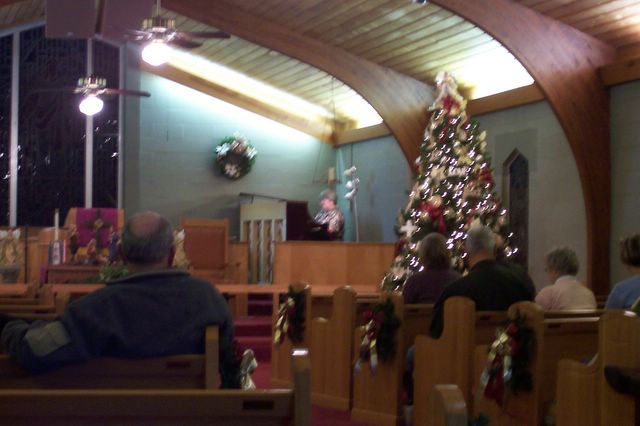

Luke 1: 26-38
Angels are perhaps the most visible part of our religion in American culture. Everywhere you turn you see angels: Books on angels, tv shows about angels. When I think of angels, I always think about War Eagle and craft fairs, because my mom always brought home an angel for her collection from craft fairs. My mother actually has a Christmas tree solely devoted to her angel ornament collection. You no doubt might think of Cary Grant as Dudley the angel in the “Bishop’s Wife” or Henry Travers as Clarence, the angel earning his wings in “It’s a Wonderful Life.” At a religion bookstore I worked at in West Hollywood, we had a whole section on angels. So, what is it about these emissaries of God that appeals so strongly to our culture? What does the Bible really say about angels? One thing that is not usually shown by our culture’s representation of Angels is the fact that they are by most accounts fairly terrifying. The first words out of an angels mouth in the Bible is usually, “Do not be afraid.” There are many accounts of angels in the Bible, but one that perhaps expresses best the otherworldly nature of these beings is Ezekial 1. Here is a detailed account of Ezekial’s vision of what is called a “cherub” and it is not quite as benign looking as a little fat baby with wings and a harp. What angels are is always played down by the Biblical texts. The most important thing about them is the message they bring. Angels are shown by scripture to be the emissaries of God. Bruggemann describes the distinction as being like political representatives of the Almighty power in heaven who come to earth bearing the Divine’s message. IN fact, the word angel simply means messenger in Greek.Angels offer encouragement, hope, assistance. Sometimes, what they bring is met by humans in struggle—As is the case with Jacob wrestling with an Angel on a riverbank. Our scripture this morning tells us that Mary is at first troubled by what the angel Gabrielle has to say to her.
The message that Gabrielle brought to Mary was that she would bear the Messiah. Though Mary does not wrestle with the angel who brought her word of the son she would bear, the news does create some strife and hardship for her life and for Joseph’s life.
Much like we today have made ready this sanctuary for the season of Advent, the angels spread the message among the people and to Mary and Joseph that they should make ready their hearts to receive a special gift: a child.
The message is clear to us today as well. Christ is born among us! Are we waiting on a dramatic divine encounter in the middle of the night to hear the news of Christ’s presence, or can we be content with the subtle miracles that tell of Christ’s birth in our lives? Hebrews 13:1-2 tells us that simply by showing hospitality to strangers, some have unknowingly entertained angels. If we live the life of hospitality in our hearts, if we let the hope of this Christ child born to Mary surround us and infuse us, we too will live among angels and be graced by their presence.
There is a song by an artist named Ben Harper called “Waiting on an angel.” In it, he references this saying from Hebrews, and declares that he’s waiting on an angel—one to carry him home. Are we preparing our heart for the season of waiting with joyful anticipation? Waiting plus joyfulness = hope. The message carried by the angels is quite often not an answer to a question, but rather the instilling of hope. Mary was asked to bear a son for nine months for the sake of world. We are asked to bear our patience and remain hopeful. This is the season of joyful anticipation. We are waiting on an angel—waiting on a message: and that message is: “Christ is born to us—go and seek him!” Amen.
Angels are perhaps the most visible part of our religion in American culture. Everywhere you turn you see angels: Books on angels, tv shows about angels. When I think of angels, I always think about War Eagle and craft fairs, because my mom always brought home an angel for her collection from craft fairs. My mother actually has a Christmas tree solely devoted to her angel ornament collection. You no doubt might think of Cary Grant as Dudley the angel in the “Bishop’s Wife” or Henry Travers as Clarence, the angel earning his wings in “It’s a Wonderful Life.” At a religion bookstore I worked at in West Hollywood, we had a whole section on angels. So, what is it about these emissaries of God that appeals so strongly to our culture? What does the Bible really say about angels? One thing that is not usually shown by our culture’s representation of Angels is the fact that they are by most accounts fairly terrifying. The first words out of an angels mouth in the Bible is usually, “Do not be afraid.” There are many accounts of angels in the Bible, but one that perhaps expresses best the otherworldly nature of these beings is Ezekial 1. Here is a detailed account of Ezekial’s vision of what is called a “cherub” and it is not quite as benign looking as a little fat baby with wings and a harp. What angels are is always played down by the Biblical texts. The most important thing about them is the message they bring. Angels are shown by scripture to be the emissaries of God. Bruggemann describes the distinction as being like political representatives of the Almighty power in heaven who come to earth bearing the Divine’s message. IN fact, the word angel simply means messenger in Greek.Angels offer encouragement, hope, assistance. Sometimes, what they bring is met by humans in struggle—As is the case with Jacob wrestling with an Angel on a riverbank. Our scripture this morning tells us that Mary is at first troubled by what the angel Gabrielle has to say to her.
The message that Gabrielle brought to Mary was that she would bear the Messiah. Though Mary does not wrestle with the angel who brought her word of the son she would bear, the news does create some strife and hardship for her life and for Joseph’s life.
Much like we today have made ready this sanctuary for the season of Advent, the angels spread the message among the people and to Mary and Joseph that they should make ready their hearts to receive a special gift: a child.
The message is clear to us today as well. Christ is born among us! Are we waiting on a dramatic divine encounter in the middle of the night to hear the news of Christ’s presence, or can we be content with the subtle miracles that tell of Christ’s birth in our lives? Hebrews 13:1-2 tells us that simply by showing hospitality to strangers, some have unknowingly entertained angels. If we live the life of hospitality in our hearts, if we let the hope of this Christ child born to Mary surround us and infuse us, we too will live among angels and be graced by their presence.
There is a song by an artist named Ben Harper called “Waiting on an angel.” In it, he references this saying from Hebrews, and declares that he’s waiting on an angel—one to carry him home. Are we preparing our heart for the season of waiting with joyful anticipation? Waiting plus joyfulness = hope. The message carried by the angels is quite often not an answer to a question, but rather the instilling of hope. Mary was asked to bear a son for nine months for the sake of world. We are asked to bear our patience and remain hopeful. This is the season of joyful anticipation. We are waiting on an angel—waiting on a message: and that message is: “Christ is born to us—go and seek him!” Amen.
Wednesday, November 29, 2006
Christ the King Sermon--Nov. 26 "King of Truth"
Scripture Texts:
Revelation 1: 4-8
John 18:33-37
Today we celebrate the Reign of Christ the King. It is an important Sunday because it is the last Sunday of the year in the Christian calendar. Last Advent, when the Christian calendar began, the focus was on the hope and dream of a savior-king, born in a stable. So, today it makes sense that the culmination of the year should reflect the actuality of that hope and dream that began last Advent.
Christ, the one who was born in a stable, who provided a model for our lives to live in a way that brings light to the world, who through crucifixion and resurrection mysteriously conveyed God’s grace to us in a real and tangible way—this same Christ is the true king of the universe—this same dusty young carpenter and dynamic and controversial preacher is one and the same as the very center of the Universe, the Ground of all Being, the Alpha and the Omega.
What does this mean for us today? How does this change our lives as they are experienced at the end of 2006 in Morris, Oklahoma? Who or why should we care if Jesus Christ assumes the role of a king—what does it mean for Christ to reign in heaven?
Mary Anderson writes on this topic in a Christian Century article, “I wonder and worry that people perceive Christ's rule to be similar to the queen of England's rule. Do we view Christ as one surrounded with the art and beauty of a tradition that is more antique than active? Do we see this figure of salvation as hopelessly outdated and practically mute in these postmodern times?
If we stretch ourselves to think in royal terms, we remember that although "king" may be an unfamiliar symbol, it is a political term. Kings rule a particular piece of geography. They may rule over a particular ethnic group. They have subjects--they have "a people." What we declare on this last Sunday of the church year is: Christ has made of us a people.”
The early church knew much persecution and difficulties in daily life. For them, the statement that “Jesus Christ is Lord” was a political statement—it carried the possible penalty of execution. In this day and age, in this country, I can walk down the street saying “Jesus Christ is Lord,” all I want with no repercussion. I can spout out that Jesus Christ is Lord till I am blue in the face and probably not even cause a stir.
I can say it at Wal-Mart, I can say it at the gas station, I can say it on the steps of the couthouse in Okmulgee, I can mention it to the postal workers at the post office, and contrary to what some of the folks on the radio tell you, I can go to the public school and say it all that I want to. These days, I can say it as much as I want—but does it carry the same meaning and message that it did when those Christians used to utter it in the Roman Empire? How does this truth make us “a people?”
This understanding of Christ is laden with political meaning for the first practitioners of Christianity. To say “Jesus Christ is Lord” was to make a declaration of independence from the Empire that knew only one Lord, the Caesar. It was a statement of bravery and rebelliousness that one living in a democratic society such as my own cannot fully comprehend. Our system of government allows me to make the statement that “Christ is Lord” without any fear of arrest, torture, or execution. So to some extent, my affirmation that “Christ is Lord” does not have the same potency as the same words uttered by early martyrs of the Church. However, I understand the words “Christ is Lord” to still carry political and economic meaning.
When I say these words, I commit myself to Christ over and beyond my commitments to any particular form of government, dogma, or other “power or principality.” As the early Christians committed themselves to Christ as Lord and thus turned their attention to alleviating the woes of the powerless and dispossessed people of the Empire, I see the direction of Christ pointing me toward the same ends.
The Lordship of Christ reigns in a Kingdom where the world has been turned upside down, and the powers and principalities that dominate the earth with callous disregard for compassion have been shaken out. Christ directs his disciples to carry out the healing and preaching that will facilitate the unveiling of this reality “in our midst.”
I associate the term “Lord” with the spirit of God who liberated the Israelites from enslavement in Egypt. I also celebrate Paul’s correlation between the Lord and freedom in 2nd Corinthians 3:17, which states, “The Lord is the Spirit; but where the Spirit of the Lord is, there is freedom.”
Instead of affirming a Lord who rules my life in a coercive manner, I celebrate Jesus Christ as the Lord who gives freedom. When I state that Jesus Christ is Lord, I am giving my loyalty to the Risen Christ. I am committing myself to be the best disciple I can be. This is the freedom that the Lordship of Christ inspires. Christ leads by example.
I call Christ Lord because Christ goes first where he wants me to go. As I follow the Lord, Christ’s leadership becomes more and more clear to my eyes. As Paul says in 1 Corinthians 13:12, “For now we see in a mirror, dimly, but then we will see face to face. Now I know only in part; then I will know fully, even as I have been fully known.”
Our scripture today from John shows us an instance of Pilate looking in the mirror and not being able to make out much of anything at all. Here Pilate is interrogating Jesus and is trying to determine whether this figure before him is a threat to his rule or not. The talk on the streets is that he is. They are proclaiming him the King of the Jews, the Son of David—and Pilate is familiar enough with his assigned territory to know what that means.
The people evidently think this is a candidate for insurrection. They want to see Jesus do the same things that David did, namely rout their enemies out of Palestine and regain power for themselves. This was something that could not happen if the Pax Romana, the Roman Peace, was to be preserved. Interestingly, in Pilate’s interrogation of Jesus, he becomes the one who becomes interrogated. Jesus masters him and turns his questions on their head. He invites Pilate to know him theologically, not simply politically. Pilate can’t get beyond the politics though, and ironically answers his own question “I am not a Jew, am I?” with a positive. You see, John used the word, “Jews,” not so much ethnically but instead to label those who did not hear and believe the truth of Jesus.
Pilate asks Jesus, “So you are a king?” Jesus replies, “You say that I am a king, for this I was born, and for this I came into the world: to testify to the truth. Everyone who belongs to the truth listens to my voice.” Then Pilate asks the question, “What is truth?” What an interchange! One king asking the true king, “what is truth?” We want to know too. John uses the word truth in 21 verses in his Gospel, and evidently the concept is important to him. Jesus is the king of Truth, he is the truth, and we want Jesus to be a little more descriptive about his kingdom.
Jesus speaks about Truth as though it can possess us. He has come into the world to testify to the Truth. The truth possesses him, for sure, and another thing, if we belong to the Truth, we listen to his voice. So what does it mean for us today that Christ is King? It means that Christ invites us to be owned by the Truth. And what is that truth?
That truth is that the Kingdom is here in our midst, as Jesus says in Luke 17:20. It is a Kingdom that we open our eyes to—it is a kingdom where we open our eyes to one another and see brothers and sisters. It is a kingdom in which we look at the homeless, the orphan, the prisoner, the AIDS patient, and we see royalty. What would you do if the President or some Hollywood celebrity walked into this church right now? We’d probably all fall over ourselves with respect. I’d stutter and sputter and try to find some way to present our little fellowship here in a dignified manner. We’d be star-struck.
Christ is the King of the kingdom in which all of these people are more than celebrities or dignitaries, they are Children of God. What is truth?, Pilate asks, “The truth,” says Jesus, “shall set you free!” Living in this awareness does indeed set us free. It sets us free to be loved by God despite ourselves. The truth is grace. God’s grace is the truth that is the secret of the universe. It is like a pearl of great price, it is like a lost coin found and celebrated. Grace gives us the eyes to see our fellow brothers and sisters through the light of love. Grace gives us the eyes to see God’s presence in all of creation. Grace gives us the freedom to look at ourselves in the mirror and know that God loves us as we are.
Christ is King, indeed. Christ is the King who sets us free by giving us the truth—the truth that God loves us unconditionally. This unconditional kingdom is not just a time in the future when Christ comes in victory to usher in this understanding all over the world, it is a condition of the heart in the present. Christ can reign RIGHT NOW in our hearts if we open our hearts to the grace of God and put that grace into action in our lives and in our encounters with others. Christ says, “I am the Alpha and the Omega, who was and is and is to come.” Christ’s reign is not constrained by time, it is outside of time. It comes to us whenever we love one another, as Christ commanded us in the Gospel.
Can you imagine? John’s account of the interaction between Pilate and Jesus ends in a question. Jesus does not give an answer to Pilate’s question “what is truth?” But if he had, we can imagine what his answer might have been based on our reading of the rest of the Gospel. Jesus might have said, “My son, the truth is that God loves you and accepts you despite what you will do to me. This truth should be powerful enough for you to change your life—for you to walk in a way that leads to the light and glory of God.” Jesus had said earlier in John, “I am the way, the truth, and the life.” The answer to Pilate’s question, “What is truth?” was sitting right in front of him.
Jesus might have used the words from the Revelation to John, “every eye will see me, even those who pieced me, and on account of me, all of the tribes of the earth will wail.” The truth is that the love that shines from God through the life and death of who in Pilate’s eyes was an ordinary peasant insurrectionist is a love that is intended for everyone. “To him who loves us and freed us from our sins by his blood, 6and made us to be a kingdom, priests serving his God and Father, to him be glory and dominion forever and ever. Amen”
Revelation 1: 4-8
John 18:33-37
Today we celebrate the Reign of Christ the King. It is an important Sunday because it is the last Sunday of the year in the Christian calendar. Last Advent, when the Christian calendar began, the focus was on the hope and dream of a savior-king, born in a stable. So, today it makes sense that the culmination of the year should reflect the actuality of that hope and dream that began last Advent.
Christ, the one who was born in a stable, who provided a model for our lives to live in a way that brings light to the world, who through crucifixion and resurrection mysteriously conveyed God’s grace to us in a real and tangible way—this same Christ is the true king of the universe—this same dusty young carpenter and dynamic and controversial preacher is one and the same as the very center of the Universe, the Ground of all Being, the Alpha and the Omega.
What does this mean for us today? How does this change our lives as they are experienced at the end of 2006 in Morris, Oklahoma? Who or why should we care if Jesus Christ assumes the role of a king—what does it mean for Christ to reign in heaven?
Mary Anderson writes on this topic in a Christian Century article, “I wonder and worry that people perceive Christ's rule to be similar to the queen of England's rule. Do we view Christ as one surrounded with the art and beauty of a tradition that is more antique than active? Do we see this figure of salvation as hopelessly outdated and practically mute in these postmodern times?
If we stretch ourselves to think in royal terms, we remember that although "king" may be an unfamiliar symbol, it is a political term. Kings rule a particular piece of geography. They may rule over a particular ethnic group. They have subjects--they have "a people." What we declare on this last Sunday of the church year is: Christ has made of us a people.”
The early church knew much persecution and difficulties in daily life. For them, the statement that “Jesus Christ is Lord” was a political statement—it carried the possible penalty of execution. In this day and age, in this country, I can walk down the street saying “Jesus Christ is Lord,” all I want with no repercussion. I can spout out that Jesus Christ is Lord till I am blue in the face and probably not even cause a stir.
I can say it at Wal-Mart, I can say it at the gas station, I can say it on the steps of the couthouse in Okmulgee, I can mention it to the postal workers at the post office, and contrary to what some of the folks on the radio tell you, I can go to the public school and say it all that I want to. These days, I can say it as much as I want—but does it carry the same meaning and message that it did when those Christians used to utter it in the Roman Empire? How does this truth make us “a people?”
This understanding of Christ is laden with political meaning for the first practitioners of Christianity. To say “Jesus Christ is Lord” was to make a declaration of independence from the Empire that knew only one Lord, the Caesar. It was a statement of bravery and rebelliousness that one living in a democratic society such as my own cannot fully comprehend. Our system of government allows me to make the statement that “Christ is Lord” without any fear of arrest, torture, or execution. So to some extent, my affirmation that “Christ is Lord” does not have the same potency as the same words uttered by early martyrs of the Church. However, I understand the words “Christ is Lord” to still carry political and economic meaning.
When I say these words, I commit myself to Christ over and beyond my commitments to any particular form of government, dogma, or other “power or principality.” As the early Christians committed themselves to Christ as Lord and thus turned their attention to alleviating the woes of the powerless and dispossessed people of the Empire, I see the direction of Christ pointing me toward the same ends.
The Lordship of Christ reigns in a Kingdom where the world has been turned upside down, and the powers and principalities that dominate the earth with callous disregard for compassion have been shaken out. Christ directs his disciples to carry out the healing and preaching that will facilitate the unveiling of this reality “in our midst.”
I associate the term “Lord” with the spirit of God who liberated the Israelites from enslavement in Egypt. I also celebrate Paul’s correlation between the Lord and freedom in 2nd Corinthians 3:17, which states, “The Lord is the Spirit; but where the Spirit of the Lord is, there is freedom.”
Instead of affirming a Lord who rules my life in a coercive manner, I celebrate Jesus Christ as the Lord who gives freedom. When I state that Jesus Christ is Lord, I am giving my loyalty to the Risen Christ. I am committing myself to be the best disciple I can be. This is the freedom that the Lordship of Christ inspires. Christ leads by example.
I call Christ Lord because Christ goes first where he wants me to go. As I follow the Lord, Christ’s leadership becomes more and more clear to my eyes. As Paul says in 1 Corinthians 13:12, “For now we see in a mirror, dimly, but then we will see face to face. Now I know only in part; then I will know fully, even as I have been fully known.”
Our scripture today from John shows us an instance of Pilate looking in the mirror and not being able to make out much of anything at all. Here Pilate is interrogating Jesus and is trying to determine whether this figure before him is a threat to his rule or not. The talk on the streets is that he is. They are proclaiming him the King of the Jews, the Son of David—and Pilate is familiar enough with his assigned territory to know what that means.
The people evidently think this is a candidate for insurrection. They want to see Jesus do the same things that David did, namely rout their enemies out of Palestine and regain power for themselves. This was something that could not happen if the Pax Romana, the Roman Peace, was to be preserved. Interestingly, in Pilate’s interrogation of Jesus, he becomes the one who becomes interrogated. Jesus masters him and turns his questions on their head. He invites Pilate to know him theologically, not simply politically. Pilate can’t get beyond the politics though, and ironically answers his own question “I am not a Jew, am I?” with a positive. You see, John used the word, “Jews,” not so much ethnically but instead to label those who did not hear and believe the truth of Jesus.
Pilate asks Jesus, “So you are a king?” Jesus replies, “You say that I am a king, for this I was born, and for this I came into the world: to testify to the truth. Everyone who belongs to the truth listens to my voice.” Then Pilate asks the question, “What is truth?” What an interchange! One king asking the true king, “what is truth?” We want to know too. John uses the word truth in 21 verses in his Gospel, and evidently the concept is important to him. Jesus is the king of Truth, he is the truth, and we want Jesus to be a little more descriptive about his kingdom.
Jesus speaks about Truth as though it can possess us. He has come into the world to testify to the Truth. The truth possesses him, for sure, and another thing, if we belong to the Truth, we listen to his voice. So what does it mean for us today that Christ is King? It means that Christ invites us to be owned by the Truth. And what is that truth?
That truth is that the Kingdom is here in our midst, as Jesus says in Luke 17:20. It is a Kingdom that we open our eyes to—it is a kingdom where we open our eyes to one another and see brothers and sisters. It is a kingdom in which we look at the homeless, the orphan, the prisoner, the AIDS patient, and we see royalty. What would you do if the President or some Hollywood celebrity walked into this church right now? We’d probably all fall over ourselves with respect. I’d stutter and sputter and try to find some way to present our little fellowship here in a dignified manner. We’d be star-struck.
Christ is the King of the kingdom in which all of these people are more than celebrities or dignitaries, they are Children of God. What is truth?, Pilate asks, “The truth,” says Jesus, “shall set you free!” Living in this awareness does indeed set us free. It sets us free to be loved by God despite ourselves. The truth is grace. God’s grace is the truth that is the secret of the universe. It is like a pearl of great price, it is like a lost coin found and celebrated. Grace gives us the eyes to see our fellow brothers and sisters through the light of love. Grace gives us the eyes to see God’s presence in all of creation. Grace gives us the freedom to look at ourselves in the mirror and know that God loves us as we are.
Christ is King, indeed. Christ is the King who sets us free by giving us the truth—the truth that God loves us unconditionally. This unconditional kingdom is not just a time in the future when Christ comes in victory to usher in this understanding all over the world, it is a condition of the heart in the present. Christ can reign RIGHT NOW in our hearts if we open our hearts to the grace of God and put that grace into action in our lives and in our encounters with others. Christ says, “I am the Alpha and the Omega, who was and is and is to come.” Christ’s reign is not constrained by time, it is outside of time. It comes to us whenever we love one another, as Christ commanded us in the Gospel.
Can you imagine? John’s account of the interaction between Pilate and Jesus ends in a question. Jesus does not give an answer to Pilate’s question “what is truth?” But if he had, we can imagine what his answer might have been based on our reading of the rest of the Gospel. Jesus might have said, “My son, the truth is that God loves you and accepts you despite what you will do to me. This truth should be powerful enough for you to change your life—for you to walk in a way that leads to the light and glory of God.” Jesus had said earlier in John, “I am the way, the truth, and the life.” The answer to Pilate’s question, “What is truth?” was sitting right in front of him.
Jesus might have used the words from the Revelation to John, “every eye will see me, even those who pieced me, and on account of me, all of the tribes of the earth will wail.” The truth is that the love that shines from God through the life and death of who in Pilate’s eyes was an ordinary peasant insurrectionist is a love that is intended for everyone. “To him who loves us and freed us from our sins by his blood, 6and made us to be a kingdom, priests serving his God and Father, to him be glory and dominion forever and ever. Amen”
Subscribe to:
Posts (Atom)